Vulse ArtVulse Art
Home/How-to Guides

Improve Your LinkedIn Reach: The Best 5 Tools For Engaging Content Creation

  • How-To Guides|
  • LinkedIn Strategy
blog-image

Standing out from the noise on LinkedIn requires more than just great ideas; it requires great tools to bring those ideas to life.


Whether you're looking to boost your personal brand, improve your company's activity, or engage more effectively with your network, the right content creation tools can make the difference.


Here's a list of the top 5 tools that can transform your LinkedIn content from good to unforgettable, starting with the innovative features of Vulse.


1. Vulse - The Leading Tool For LinkedIn Content Creation


Vulse is not just another tool for LinkedIn users; it's a game-changer.


Designed for employee advocacy and personal branding, it offers an intuitive platform that simplifies content creation, making it easier to craft, edit, and publish high-quality posts and articles.


With its user-friendly interface and advanced features, Vulse helps you create content that resonates with your audience, driving engagement and enhancing your professional reputation.


Key Features:
 

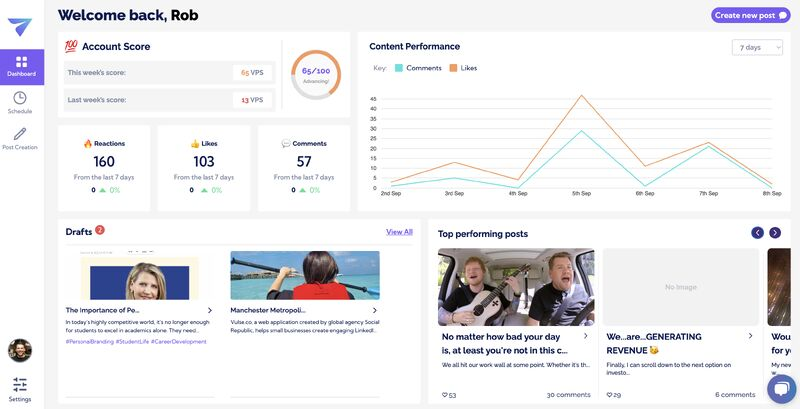
  • Account scoring system: Stay consistent by tracking your post performance.
  • Content creation tools: Create posts in seconds.
  • Analytics: Gain insights into your content's performance.
     

2. Canva - Your Go-To For Eye-Catching Visuals
 

In a platform where first impressions are crucial, Canva empowers users to create professional, visually appealing graphics that complement their LinkedIn content. With thousands of templates and easy-to-use design tools, Canva is perfect for those looking to add a touch of creativity to their posts without needing a background in graphic design.
 

Key Features:
 

  • User-friendly design interface.
  • A vast library of templates and design elements.
  • Integration with social media platforms for easy sharing.
     

3. Grammarly - The Ultimate Writing Assistant
 

Grammarly goes beyond basic spell-checking by offering comprehensive writing assistance that ensures your LinkedIn content is not only error-free but also engaging and clear. Whether you're crafting a detailed article or a quick post, Grammarly's suggestions can help you communicate your ideas more effectively.
 

Key Features:
 

  • Advanced grammar and spell-check.
  • Style and tone suggestions.
  • Plagiarism checker.
     

4. Hootsuite - Streamline Your Content Strategy
 

Managing your LinkedIn presence alongside other social media platforms can be a daunting task. Hootsuite simplifies this process by allowing you to schedule posts, track engagement, and analyse the performance of your content across multiple platforms, including LinkedIn.
 

Key Features:
 

  • Post-scheduling and management.
  • Analytics to track content performance.
  • Integrated content calendar.
     

5. BuzzSumo - Uncover Trending Content Ideas
 

Staying relevant is key to engaging your LinkedIn audience. BuzzSumo helps you discover trending topics and content ideas within your industry, allowing you to create posts that are timely and resonate with your followers.
 

Key Features:
 

  • Content discovery and insights.
  • Trend analysis for timely content creation.
  • Competitor content analysis.


Utilising the right tools can significantly enhance the engagement and reach of your LinkedIn content.


From the leading content creation tools of Vulse to the design power of Canva, these tools equip you to build a more engaging and professional LinkedIn presence.


Start exploring these tools today and take your LinkedIn strategy to the next level.


Make every post count by choosing tools that align with your goals and audience needs.

Vulse ArtVulse ArtVulse Art
Vulse Art

You May also be interested in

  • blog img

    Simple LinkedIn Post Framework For Employee Advocates To Boost Reach And Trust

    In this guide, we share a repeatable, tested framework your employees can use to write LinkedIn posts that increase reach, drive engagement, and protect authenticity.Use these steps to coach advocates, run quick experiments, and measure wins.Learn a 5-part LinkedIn post framework optimized for employee sharing.Includes example templates, testing tips, and measurement signals.Designed to keep posts authentic while improving reach and CTR.Why a simple framework mattersMany employee advocates want to help but don’t know how to turn ideas into posts that perform on LinkedIn.A clear, short framework reduces friction and preserves each person’s voice while aligning content with business goals.Purpose: teach non-writers a reliable structure that balances authenticity and discoverability so your program drives measurable results.The 5-part LinkedIn post frameworkUse these five elements in order. Not every post needs all five, but this sequence is your baseline for consistent performance.1. Hook (1–2 lines)Start with a single strong sentence that creates curiosity, states a clear benefit, or challenges an assumption. Short hooks drive more clicks and reduce scroll fatigue.Examples: "Why our launch failed in week one" or "3 small habits that doubled my focus."2. Value or story (2–4 short paragraphs)Deliver practical value or a concise personal story. Keep paragraphs to one or two sentences. Bullet lists work well here to make ideas scannable.3. Evidence or microcase (1 paragraph)Add one concrete data point, a quick example, or a mini case that supports the claim. This builds credibility without turning the post into a long read.4. Clear human CTA (call to action)End with a simple CTA that invites conversation, not sales pressure. Examples: "What do you think?" "Share a tip below." "If you’ve tried this, tell me how it went."5. Don't forget accessibilityFinish with alt text for any image you attach which helps accessibility and sometimes keeps posts clear if images don’t load.Post templates advocates can useProvide employees with short, fill-in-the-blank templates they can personalize. Templates reduce decision fatigue and increase adoption.Lesson template: “Hook. What happened. What I learned. One tip. CTA.”How-to template: "Problem. Quick steps (3 bullets). Result. CTA asking for others’ tips."Thought starter: “Contrarian statement. Brief rationale. One question to the audience.”Practical coaching tips for managersRun a 20–30 minute workshop to introduce the framework.Use live examples from your team’s LinkedIn to map posts to the format. Short group edits show how to maintain voice while improving structure.Encourage employees to keep a swipe file of ideas and snippets they can quickly turn into posts. Consider pairing new advocates with a mentor for the first 6–8 posts.Test and measure what mattersFocus on simple, meaningful metrics that reflect both reach and quality:Impressions and engagement rate (likes + comments divided by impressions)Qualitative signal: number of meaningful comments or DM leadsDownstream signal: clicks to content, topic mentions, or demo requestsRun A/B tests on hook styles, post length, and CTA phrasing for two weeks per test. Use internal tracking or a platform like Vulse to capture advocate-level performance.Quick checklist before publishingDoes the first line create curiosity or state a benefit?Is the post under 250 words and broken into short paragraphs?Is there a clear CTA that invites conversation?Have you added 2–4 relevant hashtags and alt text for images?Common pitfalls and how to avoid themAvoid making posts read like ads. If a post feels promotional, remove the sales language and add a human insight.Don’t over-hashtag; three focused tags often outperform a long list. Finally, respect employees' voices-coaching should be optional and framed as skill development.Ready-to-run experiment (7 days)Day 1: Run a 30-minute training introducing the framework.Days 2–6: Each advocate posts using one template. Track impressions and comments.Day 7: Review results and share top-performing hooks and CTAs with the team. Repeat with minor tweaks.For examples and case studies on advocate-led content that scaled, see our resources.Author:Questions and answersQ: How often should employee advocates post?A: Start with one post per week per advocate. Consistency matters more than volume; increase frequency only after measuring quality and engagement.Q: How do we keep posts authentic while aligning to brand goals?A: Use frameworks and templates, but let employees personalize language, anecdotes, and opinions. Offer optional topic buckets rather than rigid scripts.Q: Should we require approval before posting?A: Prefer guidance over gatekeeping. Use lightweight checks for regulated industries, otherwise encourage speed and authenticity with optional review for new advocates.

    Loading

    Simple LinkedIn Post Framework For Employee Advocates To Boost Reach And Trust

    by - Rob Illidge -

  • blog img

    How to Run an Employee Commenting Program to Multiply B2B Reach on LinkedIn

    Most employee advocacy programs focus on getting employees to post.That is only half the strategy.Comments are the overlooked distribution channel on LinkedIn. When your employees leave thoughtful comments on the right posts, three things happen: the original post gets more reach, your employees get more profile views, and your company builds relationships with buyers who are already engaged.The best part? A commenting program requires less time than a publishing program and often delivers faster results.Here is how to build one that works.Why Employee Comments Outperform Posts for ReachLinkedIn's algorithm prioritizes engagement over publishing frequency. According to LinkedIn's official explanation of how the feed works, the platform ranks content based on how likely it is to spark conversation. Comments are a direct signal of conversation quality.When an employee comments on a post, LinkedIn shows that post to more people in the employee's network. The comment itself also appears in their activity feed, creating a second distribution channel.This is especially powerful when commenting on posts from target accounts, industry leaders, or partners.Research from HubSpot shows that posts with higher comment volume reach significantly more people than posts with only reactions. Comments tell the algorithm this content is worth distributing.The compounding effect:Employee comments increase reach on the original postThe commenter's profile gets discovered by people viewing the threadThe comment itself can generate replies, creating ongoing visibilityWell-timed comments on trending posts multiply reach exponentiallyA single thoughtful comment can reach more people than a standalone post from an employee with a smaller network.The 30-Day Employee Commenting PilotRun a structured 30-day pilot to test formats, measure lift, and build repeatable processes. This approach minimizes time commitment while maximizing learning.Week 0: Set Goals and Choose ParticipantsDefine one primary metric:Reach lift (impressions on company posts)Profile visits (for participating employees)Referral clicks (traffic driven from comment threads to your website)Pick one. You can track others as secondary metrics, but focus on what matters most for your business.Recruit 8 to 15 employees:Mix functions and seniority levels. Include sales, customer success, product, and leadership. Different perspectives create more authentic engagement.Choose 3 content sources to target:Company posts - Your own LinkedIn content that needs amplificationPartner posts - Content from companies you collaborate withTarget account posts - Leadership and employees at your 10 most important prospectsWeek 1: Train and Provide TemplatesRun a 30-minute training session covering:What makes a good comment:Adds insight the original post did not includeAsks a clarifying or thought-provoking questionShares a short personal example or storyChallenges assumptions constructivelyProvides specific data or evidenceWhat to avoid:Generic praise ("Great post!")Self-promotion without contextLong-winded explanationsOff-topic tangentsAnything that could be perceived as argumentative or condescendingSet the cadence:Start with 3 to 5 comments per week per participant. This is manageable alongside normal work and provides enough data to see patterns.Weeks 2 to 4: Execute and IterateUse a tracking sheet or employee advocacy platform to log:Which posts were commented onWho commentedReactions and replies to the commentProfile visits during the weekAny referral traffic or leads generatedHold a 15-minute sync every week to:Share comments that generated high engagementUpdate templates based on what is workingAdjust targets if certain content sources are not performingKey insight from the pilot phase: You will quickly see which employees are natural commenters and which content sources generate the most engagement. Double down on what works.Rules of EngagementGood commenting programs prioritize helpfulness over volume. Follow these principles.Be Useful, Not PromotionalThe best comments add value to the conversation. They help the reader understand something better, see a different perspective, or ask a question they had not considered.Good example:"This aligns with what we saw in our Q4 customer research. 67% of buyers told us they prioritize ease of implementation over feature count. The challenge is getting internal teams aligned on that priority."Bad example:"We solve this problem! Check out our platform at [link]."Keep Comments 20 to 80 WordsShort comments feel conversational. Long comments feel like blog posts. Aim for 2 to 4 sentences.According to Sprout Social's 2024 engagement research, shorter, more focused comments generate higher reply rates than lengthy explanations.Tag SparinglyOnly tag people who are directly relevant to the comment. Over-tagging feels spammy and dilutes the impact.Follow Governance GuidelinesWork with your legal and compliance teams to establish:Topics that require pre-approval (regulated industries, financial projections, unannounced products)An escalation path for sensitive subjectsClear dos and don'ts based on your industryFor more on governance frameworks, see our employee advocacy governance playbook.What to MeasureKeep measurement lightweight but outcome-focused. Track three levels of data.Comment-Level MetricsReactions to the comment itselfReplies generatedThread length (how many back-and-forth exchanges occurred)These show whether the comment sparked conversation.Profile SignalsIncrease in profile views for participating employeesConnection requests from target accountsFollower growthThese show whether the comment increased discoverability.Referral OutcomesClicks to your website from LinkedInLeads attributed to comment engagementSales conversations initiated through comment threadsThese show business impact.Simple weekly report structure:EmployeeCommentsReactionsRepliesProfile ViewsReferral ClicksSarah M.5428+233James C.4315+151If you use an employee advocacy platform, most of this tracking happens automatically.Sample Comment TemplatesUse these as starting points, not scripts. Authentic comments perform better than templated ones.Quick Agreement with Added Insight"Great point, Maria. We saw customer retention improve by 18% when we made this shift in our onboarding process. The key was getting buy-in from CS leadership first."Clarifying Question That Invites Conversation"Curious how you measured adoption in the first 90 days. Did you track feature usage or rely on customer feedback surveys?"Short Story That Connects"I had a similar experience with a partner integration. A small UX change reduced setup time from 45 minutes to 12 minutes. Sometimes the smallest details have the biggest impact."Constructive Challenge"Interesting take. I wonder if this varies by company size. We found the opposite with mid-market customers, where speed mattered more than customization."Data-Driven Addition"This aligns with recent research from Gartner showing 73% of B2B buyers prefer self-service over talking to sales. The challenge is building trust without the human touch."How to Scale Beyond the PilotIf the 30-day pilot works, scale with intention.Turn Top Commenters into MentorsIdentify the 3 to 5 employees who generated the most engagement and ask them to mentor others. Share their best comments as examples in internal communications.Create a Rotating CalendarAvoid noise by rotating who comments when. Assign specific employees to specific days or content themes. This prevents comment fatigue and ensures fresh perspectives.Pair Commenting with PublishingEmployees who both publish and comment see compounding effects. Their comments drive profile views, which increases the reach of their posts. Encourage employees to comment on complementary topics to what they publish about.Recognize and RewardCelebrate wins publicly. Share weekly leaderboards, highlight standout comments in team meetings, and tie commenting activity to professional development goals where appropriate.Common Risks and How to Avoid ThemRisk: Comments Feel ScriptedFix: Use templates as prompts, not scripts. Encourage employees to rewrite in their own voice. The best comments sound like the person, not the company.Risk: Legal ExposureFix: Pre-approve sensitive topics. Create a simple checklist of what needs legal review (financials, product roadmaps, competitor claims) and provide an escalation workflow.Risk: Employee FatigueFix: Rotate duties. No one should comment every day. Build in breaks. Celebrate small wins to maintain momentum.Risk: Low Engagement on CommentsFix: Shift focus to higher-quality targets. Not all posts are worth commenting on. Prioritize posts with existing engagement, posts from target accounts, and trending industry topics.Why This Works: The LinkedIn Algorithm ExplainedLinkedIn's ranking algorithm considers three main factors when deciding what content to show users: personal connections, relevance, and engagement probability.According to LinkedIn's engineering blog, the platform uses machine learning to predict which posts will generate meaningful interactions. Comments are weighted heavily in this prediction model.When an employee comments on a post:LinkedIn shows the post to more of the commenter's connectionsThe comment appears in the commenter's activity feedThe original poster's content gets a ranking boostThe algorithm tests showing the post to new audiencesThis creates a compounding effect. A single thoughtful comment can expose a post to thousands of additional viewers.Real-World ResultsWhile individual results vary, teams running structured commenting programs typically see:40 to 60% increase in reach on company posts2 to 3x more profile views for participating employees15 to 25% boost in referral traffic from LinkedIn to website contentThe highest-performing programs combine commenting with consistent publishing, creating a flywheel effect where comments amplify posts and posts provide material for future comments.How Vulse Customers Run Commenting ProgramsVulse helps B2B marketing teams coordinate employee advocacy at scale. Customers use the platform to:Suggest high-value posts for employees to comment onTrack engagement on comments across the teamMeasure profile lift for participating employeesAttribute referral traffic back to specific commentsThe platform makes it easy to run a structured commenting program without spreadsheets or manual tracking. Teams can see which comments drive results and scale what works.If you are exploring employee advocacy for your team, book a demo to see how Vulse streamlines commenting programs.The Bottom LineEmployee comments are a high-leverage, low-cost way to increase authentic reach on LinkedIn. A well-designed commenting program drives visibility, builds relationships, and generates referral traffic without requiring employees to become content creators.Start with a 30-day pilot. Pick one metric. Recruit a small group. Provide templates. Track outcomes. Scale what works.The companies building commenting programs now will own distribution on LinkedIn. The algorithm rewards conversation. Your employees are the conversation.Frequently Asked QuestionsHow many comments per week should employees commit to?Start with 3 to 5 quality comments per person per week. Focus on helpfulness over volume. Track outcomes before increasing frequency.Can commenting really drive pipeline?Yes. Thoughtful comments increase profile discovery and create warm sales signals. Track referral clicks and connection requests from target accounts to validate impact.How do we make comments compliant with company policy?Build a short dos and don'ts list, route high-risk topics to legal before posting, and include an escalation workflow in your training materials. Most companies find commenting presents less compliance risk than publishing because comments are reactive, not proactive claims.What if employees do not have time to comment?Commenting takes less time than publishing. A thoughtful comment requires 2 to 3 minutes. Five comments per week is 15 minutes total. Frame it as a distribution tactic, not an additional content responsibility.How do we track which comments drive results?Use LinkedIn's native analytics to track profile views and website referrals. Employee advocacy platforms like Vulse automate this tracking and attribute outcomes to specific activities.Key TakeawaysEmployee comments are a high-leverage, low-cost distribution channel on LinkedInRun a 30-day pilot with clear goals, templates, and lightweight measurementPrioritize quality over volume and focus on helpfulness, not promotionScale by rotating participants, celebrating wins, and pairing commenting with publishingTrack profile visits, referral clicks, and engagement to prove impactWant to replicate these results? Book a demo to see how Vulse helps B2B teams coordinate employee commenting programs at scale.

    Loading

    How to Run an Employee Commenting Program to Multiply B2B Reach on LinkedIn

    by - Rob Illidge -

  • blog img

    Vulse vs Oktopost: Which LinkedIn Employee Advocacy Tool is Right for You?

    Choosing the right employee advocacy tool is a critical decision for B2B brands that want to amplify their reach on LinkedIn and beyond. In 2025, the two names that often come up in conversations are Vulse and Oktopost.While both platforms are designed to support employee advocacy, their approaches, features, and focus areas differ significantly.In this article, we break down the strengths of each tool, compare their features, and help you decide which platform best fits your business needs.Why Employee Advocacy Is Essential For B2B BrandsEmployee advocacy has become more than just a marketing strategy.It’s now one of the most effective ways to:Increase organic reach on LinkedInBuild trust and thought leadership within target industriesEmpower employees to become brand ambassadorsGenerate leads from authentic, employee-driven contentWith LinkedIn sunsetting My Company businesses need a dedicated tool to fill that gap.Vulse: The LinkedIn-Focused Employee Advocacy ToolVulse is designed specifically for B2B companies that want to maximize results on LinkedIn.Unlike general social media management platforms, Vulse leverages unique LinkedIn API access to create a more precise and effective employee advocacy experience.Key Features of Vulse:LinkedIn API integration for seamless publishing and analyticsTone-matching AI to keep employee content on-brandAccount scoring to measure advocacy effectiveness at an individual and company levelContent planning tools to simplify employee participationBuilt with B2B advocacy in mind rather than broad consumer marketingVulse is particularly strong for companies that want to focus their advocacy strategy where it matters most: LinkedIn.Oktopost: An Enterprise Social Media SuiteOktopost is positioned as a B2B social media management platform with employee advocacy included as part of its offering.Key Features of Oktopost:Broad social media scheduling and reporting across channelsEmployee advocacy as part of a larger, more expensive enterprise platformIntegrations with marketing automation and CRM toolsAnalytics for enterprise marketing teamsOktopost works best for organizations that want a high-budget, multi-channel advocacy program embedded within a broader social media strategy.Vulse vs Oktopost: Head-to-HeadFeatureVulseOktopostFocusLinkedIn employee advocacyBroad social mediaBest ForB2B companies prioritizing LinkedIn growthEnterprise teamsAI Content SupportTone-matching AI, account scoring, employee planning toolsSocial publishingEase of UseSimple and employee-friendlySuited for large, high-budget marketing teamsIntegrationsLinkedIn API, SaaS integrationsCRM, marketing automation, enterprise systemsWhich Tool is Right for You?Choose Vulse if your company is primarily focused on LinkedIn, wants AI-powered advocacy features, and values simplicity for employees.FAQs: Vulse vs Oktopost Employee AdvocacyQ1: What is the difference between Vulse and Oktopost?A: Vulse is a dedicated LinkedIn employee advocacy tool designed to boost organic reach and employee engagement, while Oktopost is a broader B2B social media management platform that also offers advocacy. Vulse focuses on simplicity, LinkedIn optimization, and employee adoption, while Oktopost emphasizes multi-channel campaign management.Q2: Which employee advocacy tool is better for LinkedIn?A: If your priority is LinkedIn employee advocacy, Vulse is purpose-built for it, with unique features like tone matching, content scoring, and LinkedIn API integration. Oktopost offers LinkedIn features too, but as part of a wider social media suite.Q3: Is Vulse more cost-effective than Oktopost?A: For companies focused on LinkedIn employee advocacy, Vulse is more cost-effective since it avoids paying for multi-channel features you may not need. Oktopost is better suited for enterprises managing complex, multi-platform campaigns.Q4: Why should companies invest in employee advocacy software?A: LinkedIn has continued limiting organic brand reach in 2025, making employee-driven sharing essential for visibility. Employee advocacy software like Vulse helps brands empower staff to amplify company content authentically.Q5: Can Vulse integrate with other marketing tools?A: Yes. Vulse integrates with LinkedIn and can be extended to other platforms, including CRMs, analytics tools, and multi-channel marketing stacks. The right choice depends on your company’s tech setup and advocacy goals.

    Loading

    Vulse vs Oktopost: Which LinkedIn Employee Advocacy Tool is Right for You?

    by - Rob Illidge -

Revolutionise Your LinkedIn Output Today

Got a question? Give us a call or start your free trail today