Vulse ArtVulse Art
Home/Linkedin Strategy

How the new LinkedIn Ad Library update can help your marketing

  • LinkedIn Strategy
blog-image

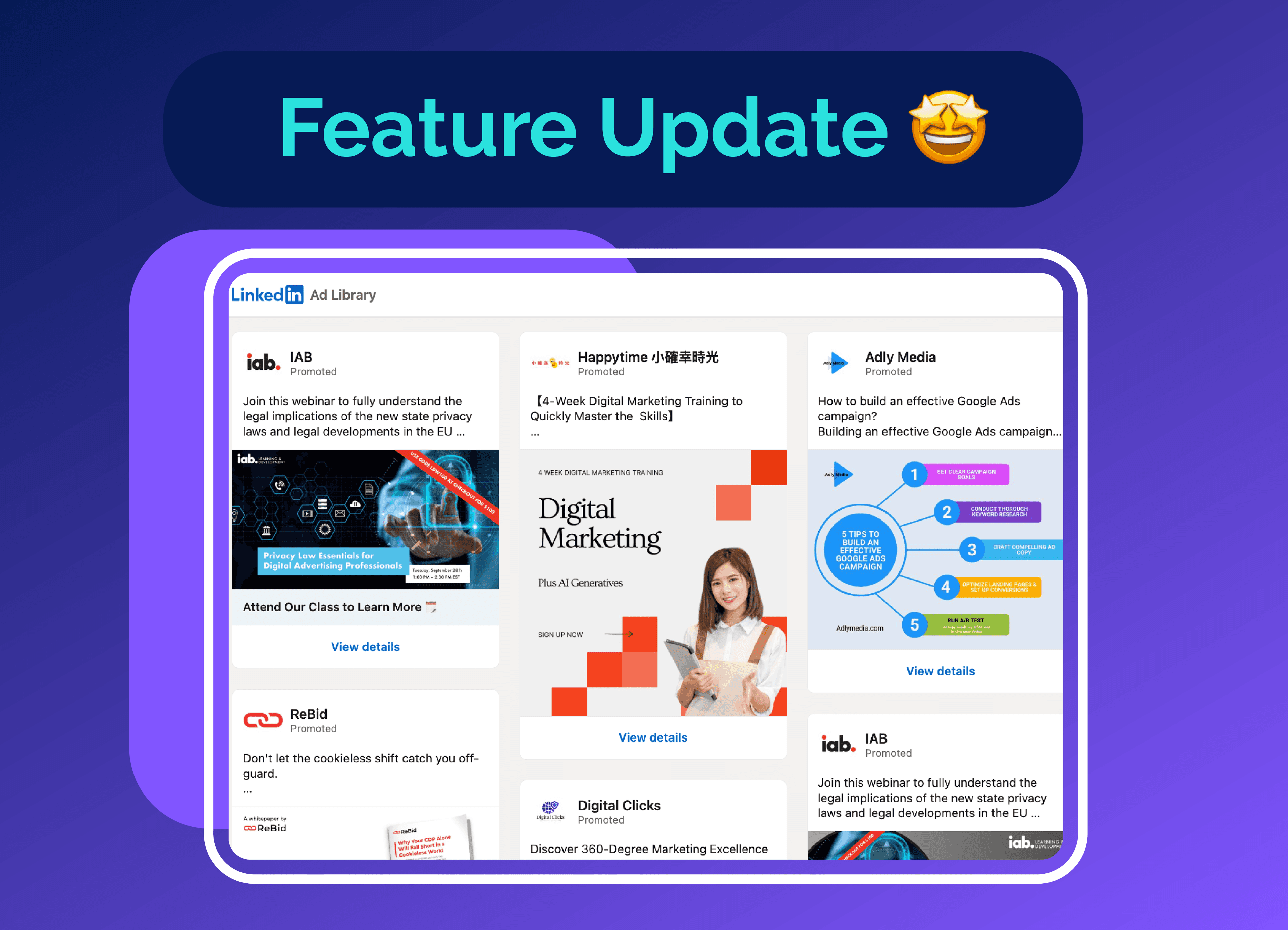
LinkedIn recently made updates to its Ad library feature that will help you gain an insight into how businesses are using brand partnerships in their campaigns. 


What is LinkedIn Ad Library?


LinkedIn ad library is a feature that allows users to explore and view ads that are running on the platform. Its aim is to increase transparency in advertising by providing information about advertisers, including their ad content, and the audience they are targeting. 


Prior to the most recent update, users could search for ads by advertisers' names, view the ad creative, and see a range of demographic information about the ad's audience, such as location, job titles, and industries. Now, LinkedIn has added a branded content library which allows users to find all influencer campaigns using keywords and dates.


Benefits of this new update


This new update is beneficial, especially for those looking to gain a competitive edge. With the vast amount of information available through this update, users can see how brands within their niche are using influencer partnerships.
 

This feature can also help you gain the information needed for a competitor analysis in your marketing efforts. Your business can use the Ad Library to gain insights into your competitor's advertising strategies, compare campaigns and see what type of content is working for a particular audience, as well as what is not working. By studying the ads that competitors were running and the audience they were targeting, you will be able to adjust your own strategies accordingly.


It is also a great resource to help you get inspired when planning content. With a wide range of ads to view within your industry, you can get new ideas for content creation and even partnerships that could benefit your brand. 


Through this update, LinkedIn is showing a new level of transparency with its users, in compliance with the new EU Digital Services Act, and providing a more trustworthy platform. With brand influencer partnerships on the rise, this feature will be essential for those looking to stay informed and ahead of the content being produced in their niche.

Vulse ArtVulse ArtVulse Art
Vulse Art

You May also be interested in

  • blog img

    How To Use LinkedIn Articles To Build Thought Leadership And Get Cited by AI Search

    Most marketers default to short LinkedIn feed posts because they are quick to write and generate immediate engagement. But if authority, search visibility, and AI citations are part of your strategy, you are leaving value on the table by ignoring LinkedIn Articles. The data makes this clear. Long-form articles and newsletters account for 60% of all AI citations from LinkedIn content, according to LinkedIn's own internal data. Feed posts drive daily visibility. Articles build the compounding authority that gets your brand cited by ChatGPT, Perplexity, and Google when buyers research your industry. The most effective LinkedIn strategies use both formats for different purposes. This guide explains when to use each, how to publish Articles that perform, and why long-form content is now a critical part of any employee advocacy and thought leadership programme. LinkedIn Articles vs Posts: What Each Format Does Best Feed posts and Articles are not competing formats. They serve different stages of the content funnel, and understanding the distinction is what separates good LinkedIn strategies from great ones. Feed posts are best for daily visibility, conversation starters, quick takes, and staying top of mind. They perform well at 200 to 300 words, generate engagement within hours, and benefit from LinkedIn's real-time algorithmic distribution. But they fade quickly. A feed post's lifespan is measured in hours to days, and they are rarely surfaced by search engines or AI tools. LinkedIn Articles are best for establishing deep expertise, earning search engine visibility, and building citable authority. They support rich formatting including headings, images, embedded video, pull quotes, and hyperlinks. They live permanently on your profile, are fully indexed by Google and Bing, and can be cited by AI search tools when answering professional queries. Here is how the two formats compare across the metrics that matter: Discoverability. Feed posts depend almost entirely on the LinkedIn algorithm for distribution. Articles are indexed by external search engines, meaning they can drive traffic from Google, AI search, and direct links indefinitely. Depth and structure. Feed posts work best as single-idea content. Articles support the heading hierarchies, internal links, and detailed formatting that LinkedIn's algorithm now uses for topical authority scoring. Lifespan. A strong feed post generates most of its engagement within 48 hours. A strong Article can continue earning views, inbound enquiries, and AI citations for months. AI citation potential. 95% of all AI citations of LinkedIn content come from original posts, not reshares. But within that original content, long-form Articles and newsletters are cited most often because they provide the depth that AI systems need to extract reliable answers. Newsletter integration. Articles can be published as recurring Newsletters, which build a subscriber base that receives notifications each time you publish. Feed posts have no equivalent subscriber mechanism. Analytics depth. Both formats offer engagement metrics, but Articles provide firmographic analytics showing which industries, job titles, company sizes, and locations engage with your content. This data is invaluable for understanding whether you are reaching decision-makers. The practical takeaway: use feed posts to stay visible and start conversations. Use Articles to build the deep, searchable authority that compounds over time. The best strategies do both. Why LinkedIn Articles Matter for AI Search Discoverability AI search engines are increasingly citing LinkedIn as a primary source for professional queries. Profound's research ranks LinkedIn as the most cited domain for professional queries across major AI search platforms. This makes LinkedIn content a direct input into how AI tools answer questions about your industry, your company, and your area of expertise. Articles are particularly well-suited for AI citation because they provide the depth and structure that large language models need to extract reliable answers. A 1,000-word Article with clear headings, specific data points, and original analysis gives an AI system far more to work with than a short feed post. LinkedIn's own guidance confirms that content substantial enough to provide meaningful answers, often in the 800 to 1,200 word range, performs best for AI discoverability. Originality is also critical: the vast majority of AI citations come from original content, not reshared material. For a deeper look at how to structure content for AI citation, see our guide on optimising employee advocacy content for AI search. How to Publish a LinkedIn Article That Performs Write a Headline That Answers a Question Your headline determines whether someone clicks through from the feed or from a search result. Effective Article headlines communicate a complete idea and mirror the way professionals search for information. "How B2B Companies Use Employee Advocacy to Generate Pipeline" outperforms "Employee Advocacy Tips" because it tells both readers and AI systems exactly what the piece covers. LinkedIn uses the first line of your post or Article title as the basis for its URL structure, which influences how search engines categorise and rank your content. Make that first line count. Structure for Both Readers and AI Use clear heading hierarchies (H2 and H3 tags) to break your Article into scannable sections. Each section should answer a specific sub-question and make sense on its own if extracted by an AI tool. This approach aligns with LinkedIn's recommendation to write for snippets: assume your content will be pulled into AI-generated answers without its surrounding context. Lead with a summary or key takeaway at the top of the Article. This gives busy readers the core message immediately and provides AI systems with a clean excerpt to cite. Set SEO Metadata Before Publishing LinkedIn's Article editor includes fields for SEO title, description, and tags. Use these to control how your Article appears in search results. Write your meta description as a direct, concise answer to the primary question the Article addresses, and keep it between 140 and 160 characters. For guidance on SEO metadata best practices, see Google's documentation on search essentials. Include Original Data and Specific Examples Articles that contain original data, proprietary insights, or detailed case studies are significantly more likely to be cited and shared. Generic advice that could appear on any marketing blog does not earn citations from AI systems or engagement from professional readers. If your company has access to platform analytics, customer data, or campaign results, use those numbers in your Articles. Our analysis of 400 million LinkedIn impressions is an example of how first-party data can drive both engagement and authority. Review Performance with Firmographic Data After publishing, use LinkedIn's native analytics to track reach, engagement, and reader demographics. Pay attention to which industries, job titles, and company sizes engage with your content. This data tells you whether your Articles are reaching decision-makers or just generating views from the wrong audience. For a detailed look at what metrics matter most, see our post on LinkedIn posting best practices. How LinkedIn Articles Fit Into Your Content Strategy Repurpose Across Channels A single LinkedIn Article can feed multiple content touchpoints. Turn key sections into shorter LinkedIn feed posts. Include the Article link in email signatures and newsletters. Reference it in sales outreach when a prospect asks about a topic you have covered in depth. This repurposing strategy extends the Article's reach beyond LinkedIn's platform and creates a hub-and-spoke content structure where the Article serves as the pillar and shorter content pieces drive traffic back to it. Build a Newsletter Audience LinkedIn's Newsletter feature lets you convert Article readers into subscribers who receive notifications each time you publish. This is one of the few organic distribution channels on LinkedIn that does not depend on the feed algorithm for reach. Newsletters are particularly valuable for employee advocacy programmes. When subject matter experts within your company publish recurring Newsletters on their areas of expertise, they build a direct audience that compounds over time. Each edition reinforces their topical authority, which the LinkedIn algorithm rewards with better distribution for all of their content, including shorter feed posts. Empower Employees to Publish The most effective Article strategies are not limited to the marketing team. Encourage executives, sales leaders, and subject matter experts to publish Articles on topics where they have genuine expertise. Employee-published content generates 14 times more engagement than company page content, and that advantage extends to long-form Articles as well. The key is to support employees with topic suggestions, editing assistance, and a clear understanding of how publishing builds their personal brand alongside the company's. For a step-by-step framework, see our employee advocacy training guide. Amplify With Paid Distribution LinkedIn's Article and Newsletter Ads allow you to promote long-form content to targeted professional audiences. Use organic engagement data to identify which Articles resonate most, then amplify those with paid distribution. This approach is more cost-effective than promoting content blind, because you already have proof that the material drives engagement. For more on combining organic and paid strategies, see our guide on Thought Leader Ads. Content Best Practices for LinkedIn Articles in 2026 Lead with value, not preamble. Open with your most important insight or a clear summary of what readers will learn. The first two lines determine whether someone continues reading. Keep sections short and scannable. Use subheadings, short paragraphs, and formatting to guide readers through the piece. LinkedIn's algorithm measures dwell time, and well-formatted content keeps people reading longer. Aim for 800 to 1,200 words. This range provides enough depth to demonstrate expertise and satisfy AI extraction requirements without losing reader attention. LinkedIn's early testing suggests this length performs best for discoverability. Include specific numbers and evidence. Statements like "employee advocacy reduces cost per click to under $1 compared to $5 to $10 for LinkedIn Ads" are more citable and more credible than vague claims about "improving performance." Write in your own voice. LinkedIn's algorithm actively deprioritises generic AI-generated content. Use AI tools to support your workflow, but make sure the final output reflects genuine expertise and a human perspective. Update and refresh published Articles. Add a "Last updated" note when you revise content. AI search engines and LinkedIn's own system both use freshness as a ranking signal. Revisiting high-performing Articles every 6 to 12 months keeps them relevant and discoverable. Checklist Before You Publish Use this as a final review before hitting publish on any LinkedIn Article. Headline and cover image. Does the headline communicate a complete idea? Is the cover image relevant and professional? Summary or key takeaway. Does the Article open with a clear statement of what readers will learn or gain? Structure and formatting. Are headings, subheadings, and paragraphs structured logically? Can each section stand alone if extracted by an AI tool? Links and references. Have you linked to supporting resources, both internal and external? Are sources for data points and claims clearly attributed? SEO metadata. Have you set the SEO title, description, and tags in the Article settings? Promotion plan. Do you have a plan for sharing the Article through employee posts, email, and paid amplification if relevant? Frequently Asked Questions What is the ideal length for a LinkedIn Article? LinkedIn's own testing suggests that Articles in the 800 to 1,200 word range perform best for both reader engagement and AI search discoverability. The goal is to provide enough depth to demonstrate expertise without losing reader attention. Do LinkedIn Articles appear in Google search results? Yes. LinkedIn Articles are fully indexed by Google, Bing, and other search engines. They can also be cited by AI search tools like ChatGPT and Perplexity when answering professional queries. How are LinkedIn Articles different from Newsletters? Articles are standalone long-form posts. Newsletters are recurring Article series that allow readers to subscribe and receive notifications each time you publish. Newsletters build a direct distribution channel that does not depend on the feed algorithm. Should employees publish LinkedIn Articles or just feed posts? Both. Feed posts are better for daily engagement and visibility. Articles are better for establishing deep expertise on specific topics and building long-term discoverability through search engines and AI citation. The most effective employee advocacy programmes use a combination of both formats. Do LinkedIn Articles count toward topical authority in the algorithm? Yes. LinkedIn's algorithm evaluates the full body of content a person publishes, including Articles, when determining topical authority. Professionals who publish consistent, substantive Articles on a specific domain see that authority reflected in how all their content is ranked. Can I republish blog content as a LinkedIn Article? You can, but original content performs significantly better. If you repurpose blog content, adapt it for the LinkedIn audience by adding personal perspective, updating data points, and adjusting the format for on-platform readability. Avoid publishing exact duplicates. Ready to turn your team into LinkedIn thought leaders? Vulse helps marketing teams create, distribute, and measure employee content that builds authority and drives pipeline. Start your free trial or book a demo to see how it works.

    Loading

    How To Use LinkedIn Articles To Build Thought Leadership And Get Cited by AI Search

    by - Rob Illidge -

  • blog img

    LinkedIn In-Network vs Out-of-Network Reach: What the New Metric Means And How to Use It

    LinkedIn has started showing creators exactly where their reach comes from. As of early June 2026, your post analytics now split impressions into two groups: people already in your network, and people who are not. It is a small interface change with a big strategic message, because the second number is the one that quietly decides whether your audience grows or stays the same. Here is the short version. In-network reach is the share of your impressions that came from your existing followers and connections. Out-of-network reach is the share that came from everyone else: people who found you through feed recommendations, reshares, and search. If you care about growth, personal branding, or proving that employee advocacy actually works, out-of-network reach is now the clearest signal you have. Key takeaways LinkedIn now breaks post reach into in-network and out-of-network percentages, shown in the discovery section under impressions. In-network reach measures how well content resonates with the audience you already have. Out-of-network reach measures how far it travels to new people. Out-of-network reach is the better proxy for audience growth, brand awareness, and advocacy performance. The update arrives alongside a refreshed, more compact format for document posts, which remain one of LinkedIn's highest-engagement formats. You can act on this immediately by tracking the split over time and doubling down on the content that consistently reaches beyond your own network. What changed in LinkedIn post analytics LinkedIn's director of creator products, Sam Corrao Clanon, confirmed the rollout in a public post on LinkedIn, and it was first reported by Social Media Today. As the feature ramps up globally, creators will see a percentage breakdown inside their post analytics that shows who saw a given post, grouped by whether or not those viewers already followed or connected with them. You will find it in the discovery section of your post analytics, sitting under your impressions count. Rather than a single reach figure, you now get the story behind that figure: how much of it stayed inside your circle, and how much spilled outside it. What is in-network reach on LinkedIn? In-network reach is the percentage of your post's impressions that came from people who already follow you or are connected to you. These are the people who chose to see your content. When in-network reach is high and engagement is strong, it tells you the post landed well with the audience you have built. It is a measure of resonance and loyalty. A post that performs almost entirely in-network is not a failure. Deep engagement from your core audience builds trust, keeps you top of mind, and often seeds the early activity that the algorithm needs before it decides whether to push a post further. What is out-of-network reach on LinkedIn? Out-of-network reach is the percentage of your reach that came from people who were not following or connected to you at the time. According to Corrao Clanon, these viewers discover you through distribution surfaces such as feed recommendations, reshares, and search. In plain terms, out-of-network reach is LinkedIn telling you, "this post escaped your bubble." It is the closest thing the platform gives you to a built-in audience growth metric, because every out-of-network impression is a chance to win a new follower, a new connection, or a new customer. Why out-of-network reach is the metric that matters most For years, LinkedIn reporting forced everyone to treat reach as a single lump sum. That hid the most important distinction in content strategy: the difference between talking to the same people again and reaching someone new. The reason the split matters comes down to how the LinkedIn feed works. The algorithm rewards content that earns early engagement and then keeps performing when shown to people beyond the author's network. Posts that travel out-of-network are, by definition, the posts the algorithm decided were worth recommending to strangers. Tracking that percentage tells you which topics, hooks, and formats have genuine pull, rather than which ones simply please the audience you already have. This is also why the metric is so valuable for two specific goals. What it means for employee advocacy The entire point of employee advocacy is to reach audiences a single company page never could. When ten, fifty, or five hundred employees post, the prize is not just more impressions, it is impressions in front of new, relevant people: their networks, and the networks beyond those. Until now, that promise was hard to prove. Out-of-network reach changes that. An advocacy programme that is working will show meaningful out-of-network percentages across its advocates, which is concrete evidence that employee content is expanding the company's audience rather than recycling it. If you manage advocates across an organisation, this is the number to put in front of your leadership. Tools that pull this data across a whole team, like Vulse's multiple account manager and automated content reports, make it possible to monitor reach quality at scale instead of one profile at a time. What it means for personal branding If you are building a personal brand, follower growth is the long game, and out-of-network reach is the leading indicator. A profile that consistently reaches outside its own network is a profile that is compounding. One that does not is, at best, holding steady. The practical move is to compare your two numbers across many posts and learn your own pattern. Some content will deepen relationships with your existing audience. Other content will introduce you to new people. The best creators do both on purpose, and they use live LinkedIn post analytics to know which is which. This new breakdown builds neatly on top of LinkedIn's earlier post performance alerts, giving you a fuller picture of how each post shapes your professional presence. How to increase your out-of-network reach You cannot control the algorithm, but you can give it more of what it rewards. Based on how out-of-network distribution works, here is where to focus. Lead with a hook that works without context. Out-of-network viewers do not know you. The first two lines have to earn the click on their own, with no assumption of prior trust. Write for shareability. Reshares are a primary out-of-network surface. Strong opinions, useful frameworks, and genuinely surprising data get shared. Vague updates do not. Use formats that travel. Document posts and carousels continue to perform strongly for engagement and dwell time, which helps content qualify for wider distribution. Make it search-friendly. Search is now an explicit out-of-network surface. Use the words your audience actually searches for, in your hook and throughout the post, rather than only insider jargon. Post consistently. A steady cadence gives the algorithm more chances to find your breakout posts. A reliable LinkedIn post scheduler and an AI post generator remove the friction that usually kills consistency. The document posts change, briefly Alongside the analytics update, LinkedIn refreshed how document posts appear in the feed, presenting them in a more compact, streamlined carousel format. It is a minor visual change, but a relevant one given that research has found document posts generate the highest engagement of any LinkedIn content type. A cleaner in-feed display could affect how often people stop, swipe, and engage, so it is worth watching your own document post performance over the coming weeks. How to track the in-network split over time A single post's breakdown is interesting. The trend across dozens of posts is where the strategy lives. The goal is to spot which themes reliably push you out-of-network, then build more content around them while still feeding your core audience the in-depth material that keeps them engaged. This is exactly the kind of analysis that is painful to do by hand and easy to do with the right reporting. If you run content for a team, especially in a sector where consistency and compliance both matter, a purpose-built LinkedIn content tool for professional services turns the raw numbers into a weekly view of what to do next. Frequently asked questions What is the difference between in-network and out-of-network reach on LinkedIn? In-network reach is the share of impressions from people who already follow or are connected to you. Out-of-network reach is the share from people who are not, who found your content through feed recommendations, reshares, or search. Where do I find out-of-network reach in LinkedIn analytics? It appears as a percentage breakdown in the discovery section of your post analytics, located under your impressions, as the feature rolls out globally through Is out-of-network reach good or bad? High out-of-network reach is generally a positive growth signal, because it means your content is reaching new people. In-network reach is not bad, though. It reflects how strongly your existing audience engages. Healthy accounts pay attention to both. Why does out-of-network reach matter for employee advocacy? Because expanding the company's audience is the entire goal of advocacy. Out-of-network reach gives advocacy managers direct evidence that employee posts are reaching new, relevant people rather than recirculating among the same connections. How can I increase my out-of-network reach on LinkedIn? Lead with a strong standalone hook, write content people want to reshare, use high-engagement formats like documents, include the terms your audience searches for, and post consistently so the algorithm has more chances to recommend your best work. Want to see exactly how far your team's LinkedIn content travels, and turn that into a report your leadership understands? See how Vulse works.

    Loading

    LinkedIn In-Network vs Out-of-Network Reach: What the New Metric Means And How to Use It

    by - Rob Illidge -

  • blog img

    How To Use LinkedIn Articles And Newsletters To Scale Employee Thought Leadership

    In this exclusive guide, we'll show you how B2B marketing and HR teams can use LinkedIn long-form content, specifically Articles and Newsletters, to build scalable employee thought leadership that drives trust, discoverability, and pipeline signals.Purpose: Practical steps to launch and scale employee-written LinkedIn Articles and Newsletters.Outcome: Increased discoverability, shareable assets, and repeatable workflows for employee advocates.Who this helps: Marketing managers, internal comms, and HR teams running employee advocacy programs.Why long-form content matters for employee personal brandsShort posts amplify reach, but Articles and Newsletters create lasting assets.They index on LinkedIn and search engines, demonstrate expertise, and give employees a reusable content hub for speaking, sales enablement, and recruiting.LinkedIn’s own guidance on newsletters and articles shows they help authors build a subscriber base and extend reach beyond a single post. See LinkedIn’s help center for how LinkedIn newsletters work.Three reasons to include Articles and Newsletters in your employee advocacy playbookSearchable credibility: Articles live on the author’s profile and can be found via Google and LinkedIn search.Subscriber momentum: Newsletters create an opt-in audience that notifies subscribers when new issues publish.Repurposable assets: Long-form pieces feed shorter posts, videos, and sales enablement collateral.How to run a low-risk pilot for employee Articles and NewslettersStart small with a 6-week pilot that focuses on coaching, templates, and measurement.Week 0: Select authors and set goalsChoose 4 to 8 employees across sales, product, and customer success.Set simple goals: subscribers, article views, and lead signals from comments or messages.Week 1-2: Train and templateRun a two-hour workshop on topic selection and storytelling. Use practical templates: intro hook, 3 insight sections, and action items.Provide a headline swipe file and SEO tips for LinkedIn Articles.Week 3-6: Publish and amplifyPublish one article per author and convert it into a weekly or biweekly newsletter issue if traction appears.Amplify through employee networks with a simple share kit: suggested post copy, hero image, and tagging guidelines.Editorial and governance rules that keep the program scalableLong form introduces brand and compliance risk if unmanaged.Put straightforward governance in place:Lightweight editorial review for claims and sensitive content.Ownership rules: authors own voice, company reviews for legal or customer references.Republishing policy: who can repurpose company blog content and how to credit sources.Measurement: metrics that matterMeasure both direct and downstream impact.Direct: article views, read time, newsletter subscribers, and engagement rate.Downstream: inbound messages, demo requests mentioning content, and link clicks to gated assets.Track a small set of KPIs and add qualitative win stories from sales and recruiting.Repurposing playbook: get more from each long form pieceExtract 3–5 short posts promoting key quotes or stats.Create a 60–90 second video summarizing the article for LinkedIn native video.Convert article sections into a downloadable slide or checklist for lead capture.Tools such as an employee advocacy platform can automate content distribution and track amplification across the team.Best practices and examplesEncourage authenticity and useful takeaways. HubSpot’s guide to LinkedIn Articles is a practical resource for structure and optimization.Also, review industry thought leadership research to understand what audiences value in long-form content.Tip: Start with customer problems, lessons learned, or unique frameworks rather than promotional pieces. Readers subscribe for insights, not pitches.Questions AnswersQ: Who should own editorial coaching for employee newsletters?A: A cross-functional content lead or communications manager should coach authors, supported by subject matter reviewers.Q: How often should employees publish newsletters?A: Start with biweekly or monthly cadence. Frequency should match the author's bandwidth and the audience response rate.Q: Can company content be republished as employee articles?A: Yes, with clear attribution and small edits to reflect the author voice. Include a republishing clause in your governance doc.

    Loading

    How To Use LinkedIn Articles And Newsletters To Scale Employee Thought Leadership

    by - Rob Illidge -

Revolutionise Your LinkedIn Output Today

Got a question? Give us a call or start your free trail today