Vulse ArtVulse Art
Home/Linkedin Strategy

LinkedIn Introduces Rotating Slideshow Banners: A New Way To Showcase Your Personal Profile

  • LinkedIn Strategy
blog-image

LinkedIn has unveiled an exciting feature for Premium Business users: auto-revolving slideshow banners for profile headers. This dynamic update offers a creative way to showcase personality, skills, and achievements, helping users make a lasting impression.


What’s New?


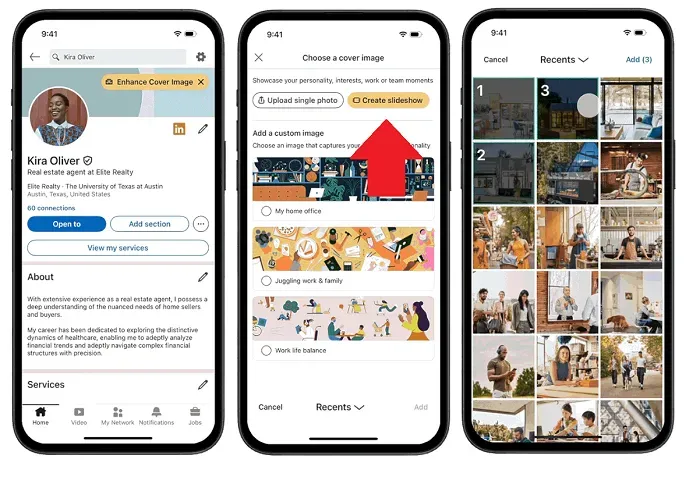
The slideshow banners allow users to upload up to five images, which rotate automatically, creating a visually engaging experience. The feature aims to enhance profiles by showcasing multiple aspects of a user’s professional journey, branding, or business offerings.


Why It Matters


This is particularly beneficial for freelancers, entrepreneurs, and creatives, allowing them to highlight key projects or offerings. Whether you're a real estate agent showcasing listings or a designer sharing your portfolio, the tool is a valuable addition to elevate your LinkedIn presence.


LinkedIn explains:


“Your LinkedIn cover image is a great tool to visually express who you are, whether it’s your personality, interests, business, or brand. For entrepreneurs and business owners, it’s an excellent opportunity to showcase more about your offering in a compelling way.


Today, we’re excited to introduce a new feature for Premium Business subscribers to make this even better: dynamic cover images. You can now select up to five photos to create a rotating slideshow on your Profile.


This is designed to help professionals make a stronger first impression, whether you’re a freelancer showcasing your services, a real estate agent highlighting current listings, or a designer spotlighting recent projects.”


Key Features of the Slideshow Tool:


  1. Dynamic Branding: Turn static headers into eye-catching banners.
  2. Enhanced Personalization: Visually express your unique story or services.
  3. Improved Visibility: Draw attention to the top of your profile, a prime digital real estate spot.
     

Who Can Use It?


Currently, this feature is exclusive to Premium Business subscribers, aligning with LinkedIn’s broader push to provide premium features like AI profile assistance and customizable CTAs. While it’s a paid feature, the added benefits for brand storytelling make it a compelling upgrade.


How to Use the Slideshow Banner:


  • Navigate to your LinkedIn profile’s banner section.
  • Select the “Create Slideshow” option.
  • Upload up to five high-quality images.
  • Customize captions and sequence to align with your profile goals.
  •  

Why Consider Premium?


In addition to the slideshow banners, LinkedIn Premium Business subscribers enjoy perks like:

  • AI-powered profile recommendations.
  • Advanced insights into profile views.
  • Customizable buttons for unique call-to-actions.
  •  

Final Thoughts


While the rotating banners might seem like a minor addition, they’re a powerful tool for those looking to stand out in 2025. As the feature rolls out globally over the next few weeks, upgrading to Premium could be worth considering for professionals aiming to amplify their LinkedIn presence.


For more details, check out the original LinkedIn post.

Vulse ArtVulse ArtVulse Art
Vulse Art

You May also be interested in

  • blog img

    How To Use LinkedIn Articles And Newsletters To Scale Employee Thought Leadership

    In this exclusive guide, we'll show you how B2B marketing and HR teams can use LinkedIn long-form content, specifically Articles and Newsletters, to build scalable employee thought leadership that drives trust, discoverability, and pipeline signals.Purpose: Practical steps to launch and scale employee-written LinkedIn Articles and Newsletters.Outcome: Increased discoverability, shareable assets, and repeatable workflows for employee advocates.Who this helps: Marketing managers, internal comms, and HR teams running employee advocacy programs.Why long-form content matters for employee personal brandsShort posts amplify reach, but Articles and Newsletters create lasting assets.They index on LinkedIn and search engines, demonstrate expertise, and give employees a reusable content hub for speaking, sales enablement, and recruiting.LinkedIn’s own guidance on newsletters and articles shows they help authors build a subscriber base and extend reach beyond a single post. See LinkedIn’s help center for how LinkedIn newsletters work.Three reasons to include Articles and Newsletters in your employee advocacy playbookSearchable credibility: Articles live on the author’s profile and can be found via Google and LinkedIn search.Subscriber momentum: Newsletters create an opt-in audience that notifies subscribers when new issues publish.Repurposable assets: Long-form pieces feed shorter posts, videos, and sales enablement collateral.How to run a low-risk pilot for employee Articles and NewslettersStart small with a 6-week pilot that focuses on coaching, templates, and measurement.Week 0: Select authors and set goalsChoose 4 to 8 employees across sales, product, and customer success.Set simple goals: subscribers, article views, and lead signals from comments or messages.Week 1-2: Train and templateRun a two-hour workshop on topic selection and storytelling. Use practical templates: intro hook, 3 insight sections, and action items.Provide a headline swipe file and SEO tips for LinkedIn Articles.Week 3-6: Publish and amplifyPublish one article per author and convert it into a weekly or biweekly newsletter issue if traction appears.Amplify through employee networks with a simple share kit: suggested post copy, hero image, and tagging guidelines.Editorial and governance rules that keep the program scalableLong form introduces brand and compliance risk if unmanaged.Put straightforward governance in place:Lightweight editorial review for claims and sensitive content.Ownership rules: authors own voice, company reviews for legal or customer references.Republishing policy: who can repurpose company blog content and how to credit sources.Measurement: metrics that matterMeasure both direct and downstream impact.Direct: article views, read time, newsletter subscribers, and engagement rate.Downstream: inbound messages, demo requests mentioning content, and link clicks to gated assets.Track a small set of KPIs and add qualitative win stories from sales and recruiting.Repurposing playbook: get more from each long form pieceExtract 3–5 short posts promoting key quotes or stats.Create a 60–90 second video summarizing the article for LinkedIn native video.Convert article sections into a downloadable slide or checklist for lead capture.Tools such as an employee advocacy platform can automate content distribution and track amplification across the team.Best practices and examplesEncourage authenticity and useful takeaways. HubSpot’s guide to LinkedIn Articles is a practical resource for structure and optimization.Also, review industry thought leadership research to understand what audiences value in long-form content.Tip: Start with customer problems, lessons learned, or unique frameworks rather than promotional pieces. Readers subscribe for insights, not pitches.Questions AnswersQ: Who should own editorial coaching for employee newsletters?A: A cross-functional content lead or communications manager should coach authors, supported by subject matter reviewers.Q: How often should employees publish newsletters?A: Start with biweekly or monthly cadence. Frequency should match the author's bandwidth and the audience response rate.Q: Can company content be republished as employee articles?A: Yes, with clear attribution and small edits to reflect the author voice. Include a republishing clause in your governance doc.

    Loading

    How To Use LinkedIn Articles And Newsletters To Scale Employee Thought Leadership

    by - Rob Illidge -

  • blog img

    You Can Now Get Paid To Train LinkedIn’s AI

    LinkedIn is taking a new approach to building better AI; it’s recruiting members to help label and annotate data.Instead of relying only on anonymous contractors, LinkedIn will invite professionals to apply their industry expertise to create high-quality, human-labelled training data, and yes, you can get paid for it.This isn’t just manual tagging.LinkedIn says it will vet applicants to make sure their background matches the annotation tasks, using profile details (education, licenses, work history) and an AI-driven conversational interview to verify expertise.Learn more about the program on LinkedIn’s help page.How the process worksProfile-based vetting and AI interviewsIf you express interest, LinkedIn may use an AI-powered conversation to ask about your professional background and assess whether you’re the right fit for specific annotation projects.The platform uses that information to match you with tasks that need specialized knowledge — for example, medical, legal, or financial labeling.Annotating industry-specific dataOnce matched, you’ll annotate examples so AI systems learn how people in your profession refer to tools, products, outcomes, and context.This helps AI models provide more accurate recommendations, search results, and professional insights across LinkedIn, and potentially for other companies that license training data.Why this matters (and why it’s complicated)Benefits for professionals and AI qualityEarn flexible, skill-based income by applying domain knowledge.Improve AI understanding of niche terms and context, leading to better matches and recommendations.Receive personalized feedback, LinkedIn may suggest profile improvements based on the interview.Ethical and career considerationsThere’s a tension here: by training AI, experts could also be helping build systems that automate parts of their own jobs.The conversation about fairness, pay, and long-term impacts of AI labor is ongoing — see a deeper dive into the industry’s reliance on human labelers in this article from The Conversation.What to consider before you sign upConfirm what tasks you’ll do, and how much you’ll be paid per assignment.Understand how your interview data will be used, LinkedIn says it will supplement your profile information to match you to projects and suggest profile updates, and will not use that info for other purposes without permission.Think about long-term implications for your role and industry.LinkedIn’s approach leverages its unique access to professionals across industries to create higher-quality, specialized training data.For people who want flexible income and enjoy applying domain expertise, it’s an attractive option, but it’s reasonable to weigh the potential trade-offs for your career.

    Loading

    You Can Now Get Paid To Train LinkedIn’s AI

    by - Rob Illidge -

  • blog img

    LinkedIn Simplifies Thought Leader Ads For Easier Discovery

    LinkedIn has made it simpler for brands to discover and sponsor user-generated content (UGC) with a new, streamlined discovery feature in Campaign Manager.This update helps marketers find relevant posts that mention their brand or event across 1st, 2nd and 3rd+ degree connections - then request permission to promote them as Thought Leader Ads.What’s new in Campaign ManagerEasier content discovery: A built-in search and highlight function surfaces posts, articles and newsletter pieces that mention your brand or event.Wider reach: You can now discover content from beyond your immediate network (including 3rd+ degree connections).Partnerships tab: Sponsored content opportunities are shown in a dedicated “Partnerships” area, and you can filter by content type to streamline outreach.Why brands should careThought Leader Ads let companies amplify authentic voices, not just company posts, by sponsoring organic content created by others.LinkedIn reports these ads see about 2x higher click-through rates than comparable single-image ads, making them an attractive option for boosting engagement and credibility.Key benefits:Authenticity: Boosting real users’ posts can feel more trustworthy than brand-only messaging.Efficiency: Built-in discovery reduces time spent hunting for promotable content.Scale: Access to 3rd+ degree posts expands potential sponsorship candidates.How to use LinkedIn Thought Leader Ads (step-by-step)1) Find relevant contentUse the new discovery tools in Campaign Manager’s Partnerships tab to surface posts, LinkedIn articles or newsletters that mention your brand or event.2) Get permissionBefore promoting anything, request sponsorship permission from the content creator. LinkedIn’s workflow in Campaign Manager makes it easier to send and track those requests.3) Launch a campaignOnce approved, you can convert the organic post into a Thought Leader Ad and run it with your chosen targeting and budget.Creator monetization: a possible next stepWhile the current process focuses on sponsorship permission, the improved discovery flow could lay groundwork for future monetization for creators.If LinkedIn decides to share ad revenue with creators whose posts are sponsored, it could create a new incentive for posting brand-positive content.That said, brands and platforms should balance monetization with authentic dialogue; paid incentives can unintentionally skew commentary.Coverage and context on LinkedIn’s broader creator efforts:Best practices for brandsPrioritize relevancy: Sponsor posts that genuinely align with your messaging and values.Be transparent: Clearly communicate sponsorship terms with creators.Measure performance: Compare Thought Leader Ads’ CTR and engagement to other ad types to understand ROI.Respect authenticity: Avoid pressuring creators into overly promotional content; authentic endorsements perform best.LinkedIn’s updated discovery tools make Thought Leader Ads easier to find and activate, opening up new opportunities to amplify user voices and boost campaign performance.As this feature rolls out to more countries, it’s worth testing Thought Leader Ads alongside existing ad formats to see how UGC-driven promotions perform for your brand.

    Loading

    LinkedIn Simplifies Thought Leader Ads For Easier Discovery

    by - Rob Illidge -

Revolutionise Your LinkedIn Output Today

Got a question? Give us a call or start your free trail today