Vulse ArtVulse Art
Home/Linkedin Strategy

LinkedIn’s Top Tips for Short-Form Video - How To Maximise Engagement

  • LinkedIn Strategy
blog-image

LinkedIn has recently embraced the power of short-form video, introducing a full-screen, vertical video feed designed to enhance user engagement and align with the rising popularity of TikTok-style content.


With video consumption on LinkedIn growing rapidly—immersive video views have increased sixfold quarter-over-quarter, and total video viewership is up 36% year-over-year—LinkedIn is encouraging creators to take advantage of this dynamic new format to reach broader audiences.


To support professionals and brands in making the most of LinkedIn’s immersive video features, LinkedIn has shared essential tips for successful short-form video content creation.


These insights are particularly valuable for SaaS companies and B2B marketers looking to enhance brand visibility and connect with LinkedIn’s professional audience. Here’s what you need to know to maximize your video strategy on LinkedIn:


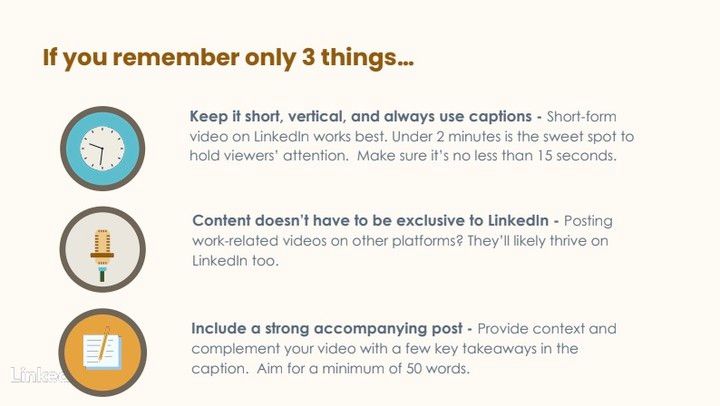
1. Keep it Short, Vertical, and Captivating
 

  • Optimal Length: Videos that are under 2 minutes but longer than 15 seconds perform best on LinkedIn’s platform. This duration holds viewers' attention while still delivering value.
  • Vertical Format: For maximum engagement, shoot videos in a vertical format (9:16 aspect ratio) with a resolution of 1080 x 1920. This immersive style allows users to swipe through content effortlessly, mirroring the TikTok experience.
  • Use Captions: Make sure your videos are accessible to all viewers by including captions, ensuring your message is understood even when sound is muted.
     

2. Focus on Relevant and Shareable Content
 

  • Content that Works: LinkedIn videos should offer standalone knowledge, industry insights, or even lighthearted workplace humor, as long as it’s appropriate. Videos with clear audio, a fast-paced rhythm, and a strong hook at the beginning tend to perform well.
  • Encourage Engagement: Videos that prompt viewers to reshare or comment see higher engagement rates. Include a strong call-to-action, encouraging users to interact with the content.
  • Avoid Overly Promotional Content: Stick to providing value and sharing insights rather than direct promotions, which tend to perform poorly on LinkedIn.
     

3. Include a Strong Accompanying Post
 

  • Add Context: Complement your video with a thoughtful caption of at least 50 words. Summarize key takeaways, provide context, or share relevant statistics to add depth to the content.
  • Optimize for SEO: Use industry-relevant keywords in the post description to make your video more discoverable on LinkedIn and search engines. Phrases like “LinkedIn video tips,” “short-form video strategy,” and “B2B video marketing” can help your content reach the right audience.
     

4. Technical Requirements for LinkedIn Videos
 

  • File Size and Types: LinkedIn supports various file types, including MP4, MOV, and AVI, with a maximum file size of 5GB and a minimum size of 75KB. Make sure your video meets these specifications before uploading.
  • Resolution and Ratios: Stick to a 9:16 vertical aspect ratio to ensure your video looks its best on mobile devices and in the immersive video feed.


What to Avoid in LinkedIn Video Content
 

  • Content to Skip: Avoid overly promotional material, controversial topics, or content that includes hate speech or misinformation. Videos should always have context and a post copy to support their message.
  • Soundless Videos with Insufficient Context: Videos lacking audio or a clear narrative may fail to resonate with audiences. Include clear visuals or captions to maintain engagement.
     

Key Takeaways
 

LinkedIn’s new video format offers an excellent opportunity for brands to connect with a younger, more digitally engaged audience. By keeping videos concise, engaging, and professionally relevant, businesses can build stronger connections, boost engagement, and make a lasting impact.


This approach is particularly useful for SaaS companies seeking to position themselves as thought leaders in their industry.


With these insights, your brand can create LinkedIn videos that not only capture attention but also drive meaningful engagement on the platform. Make the most of LinkedIn’s latest video features and start seeing the impact today.

Vulse ArtVulse ArtVulse Art
Vulse Art

You May also be interested in

  • blog img

    LinkedIn Launches Conversational AI Search

    LinkedIn just added another AI layer to its platform: conversational search. Instead of tinkering with multiple filters, you can now type a plain-language request like 'ex-coworkers who became founders in healthcare in NY' and get people, pages, and posts that match your query.The feature is currently rolling out to LinkedIn Premium subscribers in the US and will reach more members soon.This change is part of LinkedIn's broader push to embed AI across the app, supported by parent company Microsofts continued investments in AI research and products. For context on Microsofts AI focus, see the Microsoft AI blog.How conversational search works and where it helpsPlain-language queries, smarter matchesConversational search lets you describe what you need in natural language. That lowers the barrier for non-technical users who previously had to combine multiple filters to locate specific people or content. Recruiters, partnership leads, and sales teams may find it especially useful for discovering niche expertise or overlooked connections in their network.Typical use casesFinding specialized talent, for example, ‘angels with FDA experience for an early biotech’Reconnecting with former colleagues who moved into relevant rolesFinding content or pages relevant to a niche topic without manual filteringPrivacy and accuracy considerationsWhile this feature sounds powerful, it raises some important questions:Data scope: LinkedIn can only search what users have shared on their profiles and posts. That limits results to publicly available or network-visible data.Representation: People tend to present their best professional selves on LinkedIn, so results may skew positive or omit relevant but unflattering details.Sensitive queries: Historically, features like Facebooks Graph Search exposed privacy risks by enabling granular searches. For more background, see the discussion of Graph Search and its implications at https://news.ycombinator.com/item?id=5100679 and consider how platforms must balance utility with privacy.LinkedIn will need strong guardrails to prevent enabling searches that could be used to surface sensitive personal information or to target people unfairly.Tips for professionals and recruiters using conversational searchFor job seekers and talentAudit your profile: Update headlines, skills, and experience to reflect how you want to be found.Use privacy settings: Review what information is public vs network-only to control visibility.Be authentic: AI can surface inconsistencies if you overstate skills or experience.For content creators and employee advocatesOptimize your profile and posts: Use clear keywords in your summary and content to improve discoverability with natural-language queries.Encourage teammates to update profiles: A consistent, accurate employee presence helps your company surface as a trusted source. Learn how employee advocacy can amplify reach at https://vulse.co/.What to watch nextLinkedIn has already added conversational language queries for job discovery, and its evolving AI toolkit keeps getting broader. Expect more targeted search enhancements and integration across LinkedIn experiences.At the same time, monitor how well the feature returns accurate and relevant matches, and whether it respects privacy boundaries.Conversational AI search promises convenience and faster discovery, but its value will depend on result quality and responsible roll-out.For organizations, this is a reminder to keep employee profiles up to date and to think strategically about how employees represent themselves online.For additional reporting on this feature, see LinkedIn's announcement and a coverage piece on how LinkedIn is using AI for job discovery.Want to make the most of LinkedIn's AI search for your brand or career?Explore our platform to learn how employee advocacy and optimized profiles can increase discoverability.

    Loading

    LinkedIn Launches Conversational AI Search

    by - Rob Illidge -

  • blog img

    LinkedIn Crosscheck: Test AI Models for Free Inside LinkedIn

    LinkedIn has launched a feature that lets Premium subscribers compare AI models from OpenAI, Anthropic, Google, Microsoft and others, side by side, without paying for separate subscriptions or hitting token limits. The feature is called Crosscheck, and it is rolling out now to LinkedIn Premium subscribers in the United States, with broader availability planned for additional countries and free users. How LinkedIn Crosscheck Works Crosscheck is described by LinkedIn's Chief Product Officer Hari Srinivasan as a "blind taste test" for AI models. The experience works like this: You enter a text prompt LinkedIn returns two answers, each generated by a different AI model You choose which answer you prefer Only after making your selection does LinkedIn reveal which models produced each response The feature already supports a wide range of models. Early testing has returned responses from Anthropic, Google, MoonshotAI, Mistral, and Amazon, with more expected to be added. Crosscheck also has its own leaderboard tracking how professionals across different industries rate the various models against each other. What Crosscheck Does and Does Not Support Crosscheck is currently text-only. You cannot generate images, upload files, or access the more advanced capabilities available directly on each AI platform's native interface. What you do get is unlimited text-based conversations with no token limits, and no requirement to sign up for additional paid subscriptions to access models you want to try. On data sharing: LinkedIn states that anonymised usage data is shared with the AI model providers to help them understand performance across different professional roles and industries. According to LinkedIn's own documentation, no personally identifiable information is passed to model builders. Why This Matters for B2B Content and Advocacy Teams For marketing, content, and employee advocacy teams already working inside LinkedIn, Crosscheck removes a meaningful barrier. Testing whether Claude, Gemini, or GPT-4o produces better output for a specific use case, such as a thought leadership post, a comment response, or a newsletter section, has historically required maintaining multiple subscriptions and switching between platforms. Crosscheck consolidates that comparison inside a platform your team is already using every day. A few practical implications worth considering: For content quality benchmarking. If your team uses AI to support LinkedIn post drafting or employee content kits, Crosscheck gives you a fast, free way to identify which model produces output that resonates with your specific audience and industry vertical. For employee advocates. Employees who are less familiar with AI tools now have a low-friction way to experiment with AI assistance directly inside LinkedIn, without needing separate accounts or training on new platforms. For advocacy programme managers. The Crosscheck leaderboard, broken down by industry, could become a useful proxy for understanding which AI models are gaining traction among your target audience, informing both content strategy and tool selection. What to Watch Crosscheck is currently an early-stage product from LinkedIn Labs, and Srinivasan has acknowledged there is work to do on speed, model range, and supported prompt types. It is also US-only for LinkedIn Premium users at launch, which limits immediate access for UK and European teams. That said, LinkedIn's track record of rolling features out globally after US pilots, combined with the stated intention to extend access to free users, suggests Crosscheck will reach wider audiences within months rather than years. The Bigger Picture for LinkedIn Content Strategy LinkedIn's move to embed AI model comparison directly into the platform is part of a broader pattern. Over the past 18 months, LinkedIn has introduced AI writing assistance, AI-powered post suggestions, and now a structured way to evaluate models against each other, all within the interface where B2B professionals are already spending time. For teams running employee advocacy programmes, this trajectory reinforces a simple strategic point: LinkedIn is becoming a content production and evaluation environment, not just a distribution channel. The tools employees need to create, refine, and share professional content are converging in one place. If your team is not yet building a structured approach to LinkedIn content and employee advocacy, the platform's own investment in AI tooling is accelerating the gap between organisations that are and organisations that are not. Frequently Asked Questions What is LinkedIn Crosscheck? LinkedIn Crosscheck is a feature from LinkedIn Labs that lets Premium subscribers compare responses from different AI models side by side using a blind test format. You enter a prompt, receive two anonymous answers from different models, choose the one you prefer, and then LinkedIn reveals which models produced each response. Which AI models does LinkedIn Crosscheck include? At launch, Crosscheck includes models from Anthropic, Google, MoonshotAI, Mistral, and Amazon, with more expected to be added. LinkedIn has confirmed it plans to expand the model range as the feature develops. Is LinkedIn Crosscheck free to use? Crosscheck is currently available at no additional cost to LinkedIn Premium subscribers in the United States. LinkedIn has stated it plans to extend access to free users and additional countries, though no confirmed timeline has been given. Does LinkedIn Crosscheck share my data with AI companies? Yes. According to LinkedIn's documentation, anonymised usage data is shared with AI model providers to help them understand how their models perform across different professional roles and industries. LinkedIn states that no personally identifiable information is shared with model builders. Can I use LinkedIn Crosscheck to generate images or upload files? No. Crosscheck currently supports text-based prompts only. Image generation, file uploads, and the more advanced tools available natively on each AI platform are not supported within Crosscheck. Is there a limit on how many prompts I can send in LinkedIn Crosscheck? No. LinkedIn has confirmed there are no token limits or usage caps on text-based conversations within Crosscheck, which is one of its main advantages over testing models through their native platforms on free or limited tiers. How can employee advocacy teams use LinkedIn Crosscheck? Advocacy teams can use Crosscheck to benchmark which AI models produce the best output for specific LinkedIn use cases, such as thought leadership posts, comment responses, or newsletter sections. It is also a useful onboarding tool for employee advocates who are new to AI writing assistance, as it removes the need to sign up for separate platforms. Where can I access LinkedIn Crosscheck? Crosscheck is available through LinkedIn Labs for LinkedIn Premium subscribers in the United States.

    Loading

    LinkedIn Crosscheck: Test AI Models for Free Inside LinkedIn

    by - Rob Illidge -

  • blog img

    Top Jobs Rising in 2026: AI Leads the Way

    LinkedIn's annual Jobs on the Rise report tracks which roles are gaining momentum based on changes in user profiles between 2023 and 2025.The clear headline for 2026: AI-related roles are surging.From AI engineers to data annotators, the list reflects how rapidly businesses are adopting and adapting to new AI tools.This isn't speculation about future trends. It's based on actual hiring patterns and career transitions happening right now.The World Economic Forum's Future of Jobs Report predicted this shift, estimating that 23% of jobs would change by 2027 due to AI and automation. LinkedIn's data suggests we're already seeing that transformation accelerate.The top rising roles (U.S.): a quick snapshotAI Engineers - Building and deploying AI systemsAI Consultants and Strategists - Helping businesses apply AI effectivelyNew Home Sales Specialists - Real estate roles adapting to market shiftsData Annotators - Ensuring AI training data qualityAI/ML Researchers - Advancing the science behind AI modelsHealthcare Reimbursement Specialists - Navigating complex healthcare billingStrategic Advisors and Independent Consultants - Flexible expertise on demandAdvertising Sales Specialists - Adapting to changing media landscapeFounders - More professionals launching their own businessesSales Executives - Enterprise sales remains in high demandWhat's notable: six of the top ten roles are either directly AI-related or reflect broader shifts in how work is organised (consultants, founders, specialists).Gartner's research supports this pattern, showing AI technologies moving rapidly from hype to practical implementation across industries.Why AI roles are growing so fastAI tools that didn't exist a few years ago are now mainstream. ChatGPT reached 100 million users faster than any consumer application in history, and enterprise adoption has followed.Organisations now need:Technical talent to build and maintain AI models. The U.S. Bureau of Labor Statistics projects computer and information technology jobs will grow 15% through 2031, much faster than average.Strategists to apply AI effectively. Building AI is one thing. Knowing where it creates value is another. McKinsey's research estimates generative AI could add $2.6 to $4.4 trillion annually to the global economy, but only if organisations deploy it strategically.Quality-control roles like data annotators to ensure training data is reliable. AI models are only as good as their training data. MIT Technology Review has highlighted how data quality directly impacts AI reliability.Beyond technical jobs, the report highlights a rise in founders and independent consultants. More professionals are choosing flexible or self-employed paths as the market shifts. LinkedIn's Workforce Report shows self-employment and contract work growing steadily across industries.What this means for your careerDon't panic. Adapt thoughtfully.AI isn't simply a replacement for human expertise. These systems extend what people can do, but they don't "understand" outputs the way a trained professional does.Research from Stanford's Human-Centered AI Institute consistently shows that AI performs best when paired with human judgment, not when left to operate autonomously.That means:If you already have domain expertise, learning how to use AI tools will boost your productivity and opportunities. You understand context that AI cannot.If you lack core knowledge in your field, relying solely on AI can produce risky or sub-par results. AI can generate plausible-sounding content that's factually wrong or contextually inappropriate.Focus on complementary skillsSkills that combine domain knowledge, critical thinking, and AI fluency will be the most valuable. Harvard Business Review's analysis puts it simply: "AI won't replace humans. But humans with AI will replace humans without AI."The most valuable skill combinations include:Data literacy - Understanding how to interpret, question, and apply data insights. Data Literacy Project research shows only 24% of employees feel confident working with data.Model evaluation - Knowing when AI outputs are reliable and when they need verification.Prompt engineering - OpenAI's best practices show that how you ask AI matters as much as what you ask.Human judgment - The ability to spot where AI outputs need correction, context, or ethical consideration.Practical steps to prepare and upskillStart with purposeIdentify how AI could augment your current role rather than replace it. Ask yourself: What repetitive tasks consume my time? Where could AI handle first drafts while I focus on refinement?Anthropic's research on AI-assisted work suggests the biggest productivity gains come from using AI for structured, repeatable tasks while reserving human effort for judgment-intensive decisions.Mix learning modesCombine technical tutorials with real-world projects and mentorship. LinkedIn Learning's research shows that employees who apply new skills immediately retain significantly more than those who only complete courses.Online courses for foundational knowledgeSide projects for hands-on practiceMentorship for context and career guidanceCommunity participation for ongoing learningTake advantage of free resourcesLinkedIn Learning is offering free courses tied to the "Jobs on the Rise" skills through February 6 (check the full report for details).Other quality free resources:Google's AI Essentials courseMicrosoft Learn's AI modulesCoursera's AI for Everyone by Andrew NgWhere to learn more (trusted resources)LinkedIn's full Jobs on the Rise 2026 report - The primary source for this analysisWorld Economic Forum Future of Jobs Report - Global perspective on workforce transformationMcKinsey Future of Work insights - Research on AI adoption and workforce implicationsO*NET OnLine - U.S. Department of Labor's detailed job descriptions and skill requirementsBureau of Labor Statistics Occupational Outlook - Official U.S. job growth projectionsHow organisations can respondCompanies should invest in reskilling programmes that pair AI tool training with domain-specific knowledge. PwC's Global Workforce Hopes and Fears Survey found that 74% of workers are ready to learn new skills, but only 40% feel their employer provides adequate upskilling opportunities.The gap between employee willingness and employer investment represents both a risk and an opportunity.Internal mobility matters. LinkedIn's Workplace Learning Report shows employees at companies with strong internal mobility stay nearly 2x longer.Storytelling accelerates culture change. Employee advocacy platforms can help amplify upskilling stories, highlight internal mobility, and showcase how teams are evolving. This makes it easier to attract talent in a competitive market where candidates increasingly research company culture before applying.When employees share their learning journeys and career growth publicly, it signals that your organisation invests in people. Glassdoor research shows 86% of job seekers research company reviews and ratings before applying.The 2026 Jobs on the Rise report is a reminder that change is accelerating. AI roles are rising, but the winners will be professionals and organisations that combine human expertise with the right AI tools.The opportunity isn't about becoming an AI expert overnight. It's about understanding how AI fits into your domain and developing the judgment to use it effectively.Start where you are. Learn continuously. Share what you discover.Curious how employee advocacy can help your team ride this wave?Explore how Vulse can amplify skills, share success stories, and attract top talent. Book a demo to see how employee advocacy supports your workforce development goals.

    Loading

    Top Jobs Rising in 2026: AI Leads the Way

    by - Rob Illidge -

Revolutionise Your LinkedIn Output Today

Got a question? Give us a call or start your free trail today