Vulse ArtVulse Art
Home/How-to Guides

Top 5 Ways To Create Engaging Content On LinkedIn: Part 2

  • How-To Guides
blog-image

LinkedIn is the go-to professional network that has quickly evolved from where people congratulate each other for getting a job promotion, to a proven platform for businesses to build their brand further.


It’s important to keep in mind that posting content is just the first step and engagement is the most important aspect. Many companies don’t know how to get it right with LinkedIn posts, which are often either boring or too try-hard.  


LinkedIn provides opportunities to attract and communicate with audiences in new ways but how can your company do this? Here we outline our tried and tested top 5 ways to create engaging content on LinkedIn. 


Catch Attention With Video

Compared to other social media platforms, users spend less time on LinkedIn meaning they scroll quickly and efficiently. This is where video-led content can be a useful way to engage audiences by grabbing their attention with an eye-catching video to break up their feed.  It comes as no surprise that videos are beginning to dominate LinkedIn. Straight to the point and visually stimulating videos provide lots of information with less effort required from users. Ultimately meaning less scrolling and more watching.  Videos on LinkedIn can be between 3 seconds and 10 minutes. This means that short, GIF style videos can be posted, all the way to more in-depth discussion videos. From embedded to native video, and even video ads, there are plenty of ways to create and post video content on LinkedIn.  With people spending around an hour on YouTube every day this shows there is high demand for video content, so why not get these users engaged with LinkedIn videos instead?


Write Content Worth Reading

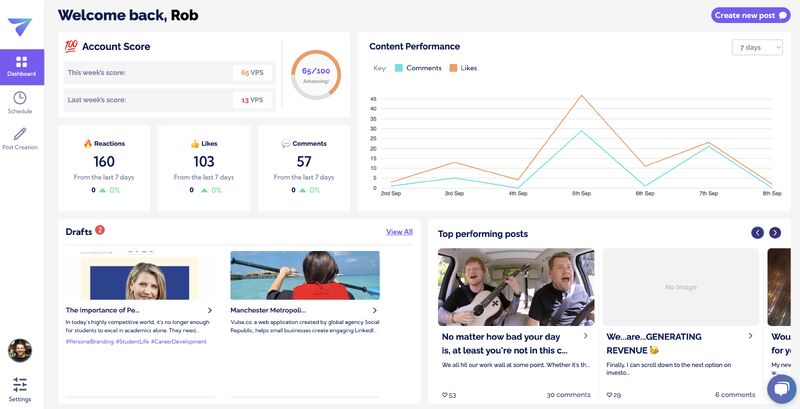
Producing stories that hook your audience is important. LinkedIn has over 2 million posts a day meaning it can be hard to cut through the noise so content needs to actually appeal to your audience. Content needs to catch the attention of readers to make sure they don’t scroll past on to the next post. So, understanding who your audience is and what kind of content hooks them is important. Vulse’s content scoring feature means the hard work is done for you. It allows you to understand how engaging content is in real-time. As you write it you can see how well your new content scores so forget ever writing content that your followers will scroll past again. 


Interact To Create Two-way Conversations

Responding to comments is key to facilitating and boosting engagement, posting the content is just step one.  Assuming that people will like, comment and share your content is wrong. You need to facilitate this extra engagement by commenting on the post yourself to start the discussions such as asking for feedback or the audience’s opinions.  Communicate with your LinkedIn followers as you would in real life and start conversations to gain greater insights and viewpoints from your audience. You'll be pleasantly surprised by the greater engagement.  


Provide Real Value To Your Audience 

Whilst sharing links on LinkedIn is common practice, your audience has probably had enough of having to click off the platform, increasing the chances of them scrolling straight past these types of posts.  Provide value by writing engaging content directly to keep people on the platform. Hook your followers with an original and interesting story.  Vulse can help you out with this, especially if you’re lacking ideas. Through the use of AI, the content scorer and hashtag checker will optimise the quality of your content. This will inevitably strengthen your presence on LinkedIn instantly. 


Plan Out Content In Advance

One good post with lots of likes, shares and comments isn’t enough. You need to be consistently engaging and a way to achieve this is by carefully pre-planning content. Don’t overdo it however, posting more than once a day has been found to result in reduced engagement. Utilising a post scheduler, such as the one integrated as a feature by Vulse, will enable you to queue posts and visualise how many posts are ready to be published.  Hashtag use is also an important aspect to focus on. Part of planning out content ensuring that relevant and relatable hashtags are part of the copy.  Are you a company needing extra help on how to create engaging LinkedIn posts?  Look no further, Vulse is on hand to assist you. Contact us today to find out more about how Vulse can help.    Let us know what you think of our top five ways to create engaging content on LinkedIn on our post on Instagram, LinkedIn or Facebook. Want to find out about LinkedIn's update to 'People You May Know'?Then head over here to give our recent blog a read.

Vulse ArtVulse ArtVulse Art
Vulse Art

You May also be interested in

  • blog img

    How to Run an Employee Commenting Program to Multiply B2B Reach on LinkedIn

    Most employee advocacy programs focus on getting employees to post.That is only half the strategy.Comments are the overlooked distribution channel on LinkedIn. When your employees leave thoughtful comments on the right posts, three things happen: the original post gets more reach, your employees get more profile views, and your company builds relationships with buyers who are already engaged.The best part? A commenting program requires less time than a publishing program and often delivers faster results.Here is how to build one that works.Why Employee Comments Outperform Posts for ReachLinkedIn's algorithm prioritizes engagement over publishing frequency. According to LinkedIn's official explanation of how the feed works, the platform ranks content based on how likely it is to spark conversation. Comments are a direct signal of conversation quality.When an employee comments on a post, LinkedIn shows that post to more people in the employee's network. The comment itself also appears in their activity feed, creating a second distribution channel.This is especially powerful when commenting on posts from target accounts, industry leaders, or partners.Research from HubSpot shows that posts with higher comment volume reach significantly more people than posts with only reactions. Comments tell the algorithm this content is worth distributing.The compounding effect:Employee comments increase reach on the original postThe commenter's profile gets discovered by people viewing the threadThe comment itself can generate replies, creating ongoing visibilityWell-timed comments on trending posts multiply reach exponentiallyA single thoughtful comment can reach more people than a standalone post from an employee with a smaller network.The 30-Day Employee Commenting PilotRun a structured 30-day pilot to test formats, measure lift, and build repeatable processes. This approach minimizes time commitment while maximizing learning.Week 0: Set Goals and Choose ParticipantsDefine one primary metric:Reach lift (impressions on company posts)Profile visits (for participating employees)Referral clicks (traffic driven from comment threads to your website)Pick one. You can track others as secondary metrics, but focus on what matters most for your business.Recruit 8 to 15 employees:Mix functions and seniority levels. Include sales, customer success, product, and leadership. Different perspectives create more authentic engagement.Choose 3 content sources to target:Company posts - Your own LinkedIn content that needs amplificationPartner posts - Content from companies you collaborate withTarget account posts - Leadership and employees at your 10 most important prospectsWeek 1: Train and Provide TemplatesRun a 30-minute training session covering:What makes a good comment:Adds insight the original post did not includeAsks a clarifying or thought-provoking questionShares a short personal example or storyChallenges assumptions constructivelyProvides specific data or evidenceWhat to avoid:Generic praise ("Great post!")Self-promotion without contextLong-winded explanationsOff-topic tangentsAnything that could be perceived as argumentative or condescendingSet the cadence:Start with 3 to 5 comments per week per participant. This is manageable alongside normal work and provides enough data to see patterns.Weeks 2 to 4: Execute and IterateUse a tracking sheet or employee advocacy platform to log:Which posts were commented onWho commentedReactions and replies to the commentProfile visits during the weekAny referral traffic or leads generatedHold a 15-minute sync every week to:Share comments that generated high engagementUpdate templates based on what is workingAdjust targets if certain content sources are not performingKey insight from the pilot phase: You will quickly see which employees are natural commenters and which content sources generate the most engagement. Double down on what works.Rules of EngagementGood commenting programs prioritize helpfulness over volume. Follow these principles.Be Useful, Not PromotionalThe best comments add value to the conversation. They help the reader understand something better, see a different perspective, or ask a question they had not considered.Good example:"This aligns with what we saw in our Q4 customer research. 67% of buyers told us they prioritize ease of implementation over feature count. The challenge is getting internal teams aligned on that priority."Bad example:"We solve this problem! Check out our platform at [link]."Keep Comments 20 to 80 WordsShort comments feel conversational. Long comments feel like blog posts. Aim for 2 to 4 sentences.According to Sprout Social's 2024 engagement research, shorter, more focused comments generate higher reply rates than lengthy explanations.Tag SparinglyOnly tag people who are directly relevant to the comment. Over-tagging feels spammy and dilutes the impact.Follow Governance GuidelinesWork with your legal and compliance teams to establish:Topics that require pre-approval (regulated industries, financial projections, unannounced products)An escalation path for sensitive subjectsClear dos and don'ts based on your industryFor more on governance frameworks, see our employee advocacy governance playbook.What to MeasureKeep measurement lightweight but outcome-focused. Track three levels of data.Comment-Level MetricsReactions to the comment itselfReplies generatedThread length (how many back-and-forth exchanges occurred)These show whether the comment sparked conversation.Profile SignalsIncrease in profile views for participating employeesConnection requests from target accountsFollower growthThese show whether the comment increased discoverability.Referral OutcomesClicks to your website from LinkedInLeads attributed to comment engagementSales conversations initiated through comment threadsThese show business impact.Simple weekly report structure:EmployeeCommentsReactionsRepliesProfile ViewsReferral ClicksSarah M.5428+233James C.4315+151If you use an employee advocacy platform, most of this tracking happens automatically.Sample Comment TemplatesUse these as starting points, not scripts. Authentic comments perform better than templated ones.Quick Agreement with Added Insight"Great point, Maria. We saw customer retention improve by 18% when we made this shift in our onboarding process. The key was getting buy-in from CS leadership first."Clarifying Question That Invites Conversation"Curious how you measured adoption in the first 90 days. Did you track feature usage or rely on customer feedback surveys?"Short Story That Connects"I had a similar experience with a partner integration. A small UX change reduced setup time from 45 minutes to 12 minutes. Sometimes the smallest details have the biggest impact."Constructive Challenge"Interesting take. I wonder if this varies by company size. We found the opposite with mid-market customers, where speed mattered more than customization."Data-Driven Addition"This aligns with recent research from Gartner showing 73% of B2B buyers prefer self-service over talking to sales. The challenge is building trust without the human touch."How to Scale Beyond the PilotIf the 30-day pilot works, scale with intention.Turn Top Commenters into MentorsIdentify the 3 to 5 employees who generated the most engagement and ask them to mentor others. Share their best comments as examples in internal communications.Create a Rotating CalendarAvoid noise by rotating who comments when. Assign specific employees to specific days or content themes. This prevents comment fatigue and ensures fresh perspectives.Pair Commenting with PublishingEmployees who both publish and comment see compounding effects. Their comments drive profile views, which increases the reach of their posts. Encourage employees to comment on complementary topics to what they publish about.Recognize and RewardCelebrate wins publicly. Share weekly leaderboards, highlight standout comments in team meetings, and tie commenting activity to professional development goals where appropriate.Common Risks and How to Avoid ThemRisk: Comments Feel ScriptedFix: Use templates as prompts, not scripts. Encourage employees to rewrite in their own voice. The best comments sound like the person, not the company.Risk: Legal ExposureFix: Pre-approve sensitive topics. Create a simple checklist of what needs legal review (financials, product roadmaps, competitor claims) and provide an escalation workflow.Risk: Employee FatigueFix: Rotate duties. No one should comment every day. Build in breaks. Celebrate small wins to maintain momentum.Risk: Low Engagement on CommentsFix: Shift focus to higher-quality targets. Not all posts are worth commenting on. Prioritize posts with existing engagement, posts from target accounts, and trending industry topics.Why This Works: The LinkedIn Algorithm ExplainedLinkedIn's ranking algorithm considers three main factors when deciding what content to show users: personal connections, relevance, and engagement probability.According to LinkedIn's engineering blog, the platform uses machine learning to predict which posts will generate meaningful interactions. Comments are weighted heavily in this prediction model.When an employee comments on a post:LinkedIn shows the post to more of the commenter's connectionsThe comment appears in the commenter's activity feedThe original poster's content gets a ranking boostThe algorithm tests showing the post to new audiencesThis creates a compounding effect. A single thoughtful comment can expose a post to thousands of additional viewers.Real-World ResultsWhile individual results vary, teams running structured commenting programs typically see:40 to 60% increase in reach on company posts2 to 3x more profile views for participating employees15 to 25% boost in referral traffic from LinkedIn to website contentThe highest-performing programs combine commenting with consistent publishing, creating a flywheel effect where comments amplify posts and posts provide material for future comments.How Vulse Customers Run Commenting ProgramsVulse helps B2B marketing teams coordinate employee advocacy at scale. Customers use the platform to:Suggest high-value posts for employees to comment onTrack engagement on comments across the teamMeasure profile lift for participating employeesAttribute referral traffic back to specific commentsThe platform makes it easy to run a structured commenting program without spreadsheets or manual tracking. Teams can see which comments drive results and scale what works.If you are exploring employee advocacy for your team, book a demo to see how Vulse streamlines commenting programs.The Bottom LineEmployee comments are a high-leverage, low-cost way to increase authentic reach on LinkedIn. A well-designed commenting program drives visibility, builds relationships, and generates referral traffic without requiring employees to become content creators.Start with a 30-day pilot. Pick one metric. Recruit a small group. Provide templates. Track outcomes. Scale what works.The companies building commenting programs now will own distribution on LinkedIn. The algorithm rewards conversation. Your employees are the conversation.Frequently Asked QuestionsHow many comments per week should employees commit to?Start with 3 to 5 quality comments per person per week. Focus on helpfulness over volume. Track outcomes before increasing frequency.Can commenting really drive pipeline?Yes. Thoughtful comments increase profile discovery and create warm sales signals. Track referral clicks and connection requests from target accounts to validate impact.How do we make comments compliant with company policy?Build a short dos and don'ts list, route high-risk topics to legal before posting, and include an escalation workflow in your training materials. Most companies find commenting presents less compliance risk than publishing because comments are reactive, not proactive claims.What if employees do not have time to comment?Commenting takes less time than publishing. A thoughtful comment requires 2 to 3 minutes. Five comments per week is 15 minutes total. Frame it as a distribution tactic, not an additional content responsibility.How do we track which comments drive results?Use LinkedIn's native analytics to track profile views and website referrals. Employee advocacy platforms like Vulse automate this tracking and attribute outcomes to specific activities.Key TakeawaysEmployee comments are a high-leverage, low-cost distribution channel on LinkedInRun a 30-day pilot with clear goals, templates, and lightweight measurementPrioritize quality over volume and focus on helpfulness, not promotionScale by rotating participants, celebrating wins, and pairing commenting with publishingTrack profile visits, referral clicks, and engagement to prove impactWant to replicate these results? Book a demo to see how Vulse helps B2B teams coordinate employee commenting programs at scale.

    Loading

    How to Run an Employee Commenting Program to Multiply B2B Reach on LinkedIn

    by - Rob Illidge -

  • blog img

    How To Measure ROI Of B2B Employee Personal Branding Programs

    Employee personal brands extend your company's reach, but without measurement, it is hard to justify resources.This guide helps B2B marketing and HR teams build a clear, defensible approach to reporting business outcomes from employee social activity on LinkedIn and other professional channels.Purpose: Turn activity into measurable outcomes.Scope: Awareness, engagement, lead signals, and talent impact.Outcome: A replicable measurement plan and dashboard checklist.Start with clear goals and mapped outcomesThe first step is to link employee activity to business outcomes. Use three goal buckets:Awareness: Reach, impressions, profile views.Engagement and trust: Comments, shares, follower growth, sentiment.Demand and talent signals: leads, meeting requests, job inquiries.For each bucket, define one primary KPI and two supporting metrics. That keeps reporting focused and aligns to stakeholders.Attribution models that work for employee advocacyEmployee posts are often organic and multi-touch. Use pragmatic attribution:Direct attribution for actions that clearly originate from an employee post, like a tracked link click that results in a demo booking.Assisted attribution for leads where employee content increased engagement during the buying process, measured via lead surveys or lead scoring uplift.Correlation tracking when direct links are missing: track timing of spikes in inbound inquiries after coordinated employee campaigns.Combine these with UTM parameters, dedicated landing pages, and short-form tracking to connect employee activity to conversions.Practical tipAlways append UTM tags to campaign links and add a hidden field or source on forms that captures "employee_post" values. This makes direct attribution clean and repeatable.Suggested KPI set for B2B teamsBelow is a compact KPI set that balances visibility and business outcomes.Reach: Total impressions and profile views from employee posts.Engagement rate: Likes, comments, shares divided by impressions.Lead signals: Demo requests, content downloads, or contact form submissions tied to employee campaigns.Talent signals: Inbound recruiter messages and job application volume resulting from employee content.Sales influence: Number of opportunities where a seller cites employee content as a touchpoint.Building a simple dashboardCombine platform analytics with CRM and web analytics to create a single source of truth. A typical dashboard has three panels:Activity panel: Posts, shares, and top-performing employees.Engagement panel: Impressions, engagement rate, and follower lift.Outcome panel: Leads attributed, demo requests, and talent inbound metrics.Use an employee advocacy solution to centralize post scheduling and analytics. See how built-in reporting can speed analysis on an employee advocacy analytics page.How to calculate a simple ROIROI for personal branding programs is often a mixture of direct revenue and soft value. Use this conservative formula to start:Sum direct revenue attributed to employee-driven leads over a period.Add estimated value of assisted conversions using a conservative uplift percentage.Divide by program cost including platform, content creation, and team time.This produces a monetary ROI figure you can present to leadership. Be explicit about assumptions and update them with real data over time.Operational checklist to scale measurementApply these practical rules to keep measurement consistent:Standardize UTMs and naming conventions across employee campaigns.Automate data ingestion from LinkedIn and your advocacy platform into your BI tool.Train employees to use trackable links and to tag campaigns in post copy when asked.Schedule a monthly review with marketing, sales, and HR to review dashboard insights.Vulse customers often pair the platform with a CRM to close the loop between post and pipeline. Learn more on our features page about LinkedIn analytics and reporting.Example: 90-day reporting cadenceRun this lightweight cadence for the first 90 days:Week 0: Baseline metrics for profiles, impressions, and leads.Week 1 to 8: Run two focused campaigns and collect UTM-tagged conversions.Week 12: Produce a stakeholder report with direct revenue, assisted conversions, and talent signal changes.Repeat and refine goals based on what moves the needle.Evidence and further readingResearch shows employee-shared content generates higher trust and click-through rates than brand-only content. For context, LinkedIn's guidance on employee advocacy provides practical benchmarks and best practices, which can help calibrate expectations: LinkedIn Marketing Solutions.For measuring social ROI and building dashboards, HubSpot's guide to social media ROI is a useful practical resource: HubSpot Blog.Frequently asked questionsQ: How soon can we expect measurable results?A: You can see awareness and engagement shifts within 30 days. Attribution to pipeline typically takes 60 to 90 days depending on sales cycles.Q: Do we need an employee advocacy tool to measure ROI?A: Tools make tracking and reporting far easier but you can start with manual UTMs and CRM tagging. A platform scales measurement and reduces manual work.Q: Which metric should executives care about most?A: That depends on priorities. For revenue-focused leaders show attributed pipeline and deals. For talent-focused teams highlight inbound candidate volume and recruiter touchpoints.

    Loading

    How To Measure ROI Of B2B Employee Personal Branding Programs

    by - Rob Illidge -

  • blog img

    How to Grow Your Presence On LinkedIn: New Data Insights Revealed

    LinkedIn has become the go-to platform for professionals to connect, share insights, and build brand reputation.With 1.2 billion members worldwide, including an estimated 480 million active users, the platform is experiencing record-high engagement levels.For businesses, founders, and professionals, the question is no longer “Should I be on LinkedIn?” but “How do I maximize my impact here?”According to Buffer’s latest LinkedIn study (covering over 2 million posts from more than 94,000 accounts), there’s one clear answer: posting frequency.Why Posting Frequency Matters on LinkedInLinkedIn’s algorithm is designed to reward activity.The more often you post, the more opportunities the system creates for your content to appear in front of your target audience.Put simply: more posts = more reach.And here’s the data to back it up:2–5 posts per week → +1,000 impressions per update6–10 posts per week → +5,000 impressions per update11+ posts per week → +16,000 impressions per updateNot only do impressions increase, but engagement (likes, comments, shares) also rises as a natural byproduct of greater visibility.Buffer notes that LinkedIn doesn’t impose a cap on reach when you post frequently — instead, it leans into your activity.Why This Matters for Professionals and BrandsLinkedIn is no longer just a recruitment tool, it’s a content platform.Conversations that used to happen on X are now shifting to LinkedIn, making it an increasingly valuable space for thought leadership, networking, and lead generation.For professionals, this means every post is an opportunity to:Showcase expertiseBuild trust with your networkReach potential clients, employers, or partnersSpark meaningful conversationsFor businesses, especially in B2B industries, LinkedIn has become one of the most cost-effective ways to build a brand presence and connect directly with decision-makers.According to LinkedIn’s Marketing Solutions data, 4 out of 5 people on the platform drive business decisions, making it a must-use channel for B2B growth.Best Practices for Posting on LinkedInWhile frequency is key, it’s not just about posting anything. To build a strong presence:Focus on value: Share content that educates, inspires, or sparks discussion.Mix formats: Use a combination of text posts, carousels, images, and video.Engage back: Reply to comments and interact with others’ content.Be consistent: Stick to a schedule — whether that’s 3 posts a week or daily updates.Test learn: Monitor impressions, clicks, and engagement to refine your approach.How Vulse Helps Agencies and Businesses Grow on LinkedInAt Vulse, we’ve seen firsthand how powerful LinkedIn can be when used strategically.Born from our own journey as an agency, we’ve built tools that make it easy to:Plan and schedule content for consistencyMatch tone of voice for employee advocacyTrack performance analytics to see what’s workingEngage with brand mentions to grow reputationBy combining Buffer’s insights on frequency with Vulse’s tools for strategy and execution, agencies and businesses can take their LinkedIn presence to the next level.LinkedIn is hungrier than ever for content. With more professionals shifting their conversations and thought leadership here, the opportunity to build visibility and influence is huge.The bottom line is post more often. Post with purpose. Post consistently.Do that, and you’ll unlock LinkedIn’s full potential for growth, connection, and opportunity.

    Loading

    How to Grow Your Presence On LinkedIn: New Data Insights Revealed

    by - Rob Illidge -

Revolutionise Your LinkedIn Output Today

Got a question? Give us a call or start your free trail today