Vulse ArtVulse Art
Home/Linkedin Strategy

What are the benefits of LinkedIn's brand partnership tags?

  • LinkedIn Strategy
blog-image

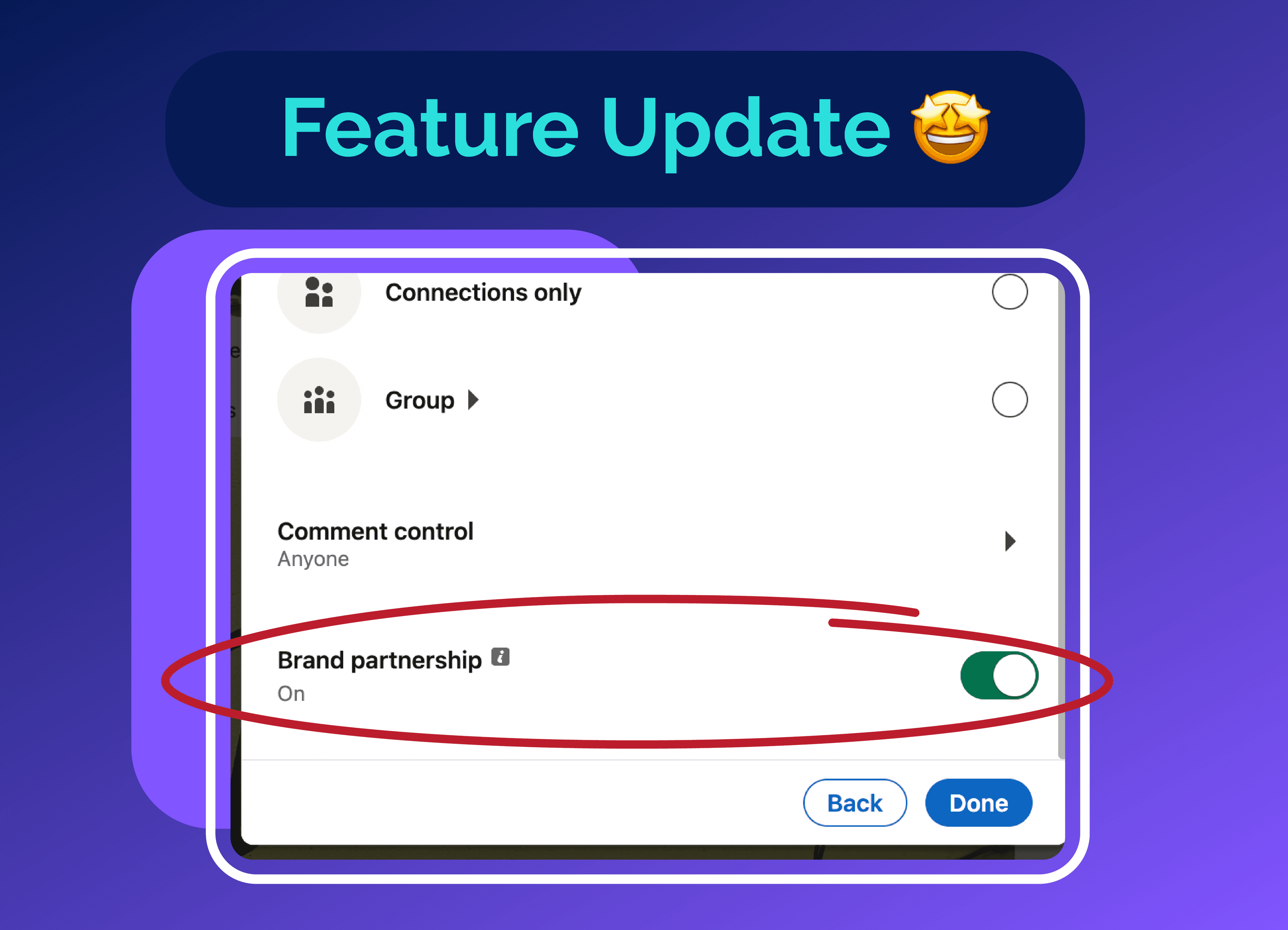
LinkedIn is lifting the veil on brand and influencer partnerships with the introduction of brand partnership tags. The brand partnership tags will appear on a post where the influencer has been paid by a third party to create or promote something. There is an option to toggle it on and off which is beneficial as a creator because it shows your audience that you are being transparent with them. 
 

Brand partnership tags on social media provide several valuable benefits for different individuals. Whether you’re an influencer, business owner, or even the audience. So what are the benefits of having these tags?
 

Enhancement of transparency and credibility


By indicating when a post is part of a paid partnership, it is providing clarity and transparency. When the followers of the influencer see that they are being open about brand collaborations, it adds to the influencer’s credibility and builds trust with the audience.
 

Extends the reach of businesses and influencers


When these brand tags are used right, they enable businesses to expand their reach. Choosing the right influencer for collaborations means opening the business up to a new audience. Your business can benefit from the trust that has already been established between the influencer and their audience. 


For influencers, brand partnership tags can open doors to potential new collaborations, increase their exposure, and give them more monetisation opportunities. 


These collaborative partnerships work well for both parties because it also makes the process of tracking and reporting easier. Businesses and influencers can clearly measure the success of their campaign and identify areas of improvement for potential future campaigns.
 

In the world of social media marketing today, the introduction of brand partnership tags makes for a win-win situation for influencers as well as business, promoting growth and building the trust of their audiences through the authenticity of their campaigns.
 

This new feature is in line with LinkedIn’s mission to provide more transparency on the platform.This is a great move for creators because LinkedIn also wants to provide them with more tools to improve their digital presence and grow on the platform. This will increase exposure for influencers and encourage more brand partnerships.


Vulse ArtVulse ArtVulse Art
Vulse Art

You May also be interested in

  • blog img

    LinkedIn Now Lets You Filter Comments by Verified Members

    LinkedIn has quietly rolled out a new comment sorting option that lets users filter replies by verified members only. It is a small interface change with significant implications for anyone using LinkedIn as a B2B content and engagement channel. Here is what the update involves and what it means for brands running employee advocacy programmes. What LinkedIn Has Changed LinkedIn has added a third sort option to post comments alongside the existing Most Relevant and Most Recent filters. The new option is called Verified Members, and selecting it shows only comments from users who have confirmed their identity on the platform. According to LinkedIn's own Help Centre documentation, the feature is designed to help members find authentic comments on posts with large comment volumes. The Verified Members filter surfaces insights from trusted professionals while reducing noise from automated, generic, or inauthentic comments. The feature is currently rolling out to a portion of users rather than the full platform, so you may not see it in your account yet. How LinkedIn Verification Works Unlike verification on Meta or X, LinkedIn verification is free. Members can confirm their identity through third-party support partners or by submitting government ID information directly. LinkedIn reported in December 2024 that more than 100 million members had verified their identity on the platform. Given that LinkedIn has over one billion members in total, verified accounts still represent roughly 10 percent of the user base, which is why the filter is a meaningful signal rather than a universal one. Why LinkedIn Is Prioritising Verified Content The timing of this update is not accidental. LinkedIn content has become a leading source for AI-generated answers, with research showing LinkedIn is among the most cited platforms by AI chatbots when generating professional and business-related responses. That citation value depends entirely on the quality and authenticity of the content being cited. If bot-generated or spam comments dilute the signal, LinkedIn's value as a trusted professional data source weakens. Surfacing verified member content is one way to protect the integrity of that data stream. There is also a straightforward commercial incentive: the more LinkedIn can demonstrate that its platform hosts authentic, high-quality professional conversations, the stronger its case for Premium subscriptions, advertising investment, and enterprise product sales. What This Means for Employee Advocacy Teams For B2B brands running employee advocacy programmes, this update has three direct implications. Verified employees carry more weight in comments. If your employees are engaging with prospects' posts, commenting on industry conversations, or responding to your own company content, a verified profile now places them in the priority tier when others filter by verification. An unverified employee advocate may not appear at all in filtered views. Verification is now a baseline, not a bonus. Until now, LinkedIn verification was something advocates could optionally pursue. This update shifts it closer to a minimum standard for anyone whose LinkedIn engagement is part of a broader business development or thought leadership strategy. Comment engagement on company posts becomes more valuable. Posts that attract verified member comments will produce higher-quality filtered feeds. Encouraging senior leaders, subject matter experts, and verified employees to comment on company content is now a deliberate reach and trust strategy, not just a vanity metric. What Advocacy Teams Should Do Now Audit your advocate pool for verification status. Identify which of your active employee advocates have completed LinkedIn's identity verification. For any unverified advocates, share LinkedIn's verification instructions and make verification part of your programme onboarding checklist. Update your advocacy programme guidelines. If you maintain a content kit, employee playbook, or onboarding document for your advocacy programme, add LinkedIn verification as a recommended first step. It takes minutes and the benefit compounds over time as the filter becomes more widely used. Prioritise comment engagement, not just post sharing. Employee advocacy programmes typically focus on sharing content from a library. This update is a prompt to also encourage employees to comment thoughtfully on relevant posts in their feed, particularly high-volume posts in your industry where a verified comment in the filtered view gives disproportionate visibility. Track verified engagement separately. If you are measuring your advocacy programme's impact, start segmenting engagement data by whether the interacting accounts are verified. This will become a more meaningful quality signal as LinkedIn continues to weight verified activity in its surfacing decisions. The Bigger Picture This update sits alongside a series of moves LinkedIn has made in 2026 to improve content quality and deepen the value of its professional data layer. Recent changes include expanded AI-powered conversational search, Crosscheck for comparing AI model outputs, and a leadership transition focused on AI development. The direction is consistent: LinkedIn is investing heavily in the credibility and quality of its professional content ecosystem. For brands whose growth depends on organic LinkedIn reach, that investment is only worth capturing if the humans representing your company in the feed are verified, active, and producing content that stands up to scrutiny. Employee advocacy built on authentic, verified professional voices is not just a nice-to-have in that environment. It is increasingly the baseline for visibility. Frequently Asked Questions What is LinkedIn's verified replies filter? It is a new comment sorting option that lets users view only comments from verified members. It sits alongside the existing Most Relevant and Most Recent filters and is designed to reduce spam and bot-generated comments in high-volume post discussions. Is LinkedIn verification free? Yes. Unlike Meta or X, LinkedIn verification does not require a paid subscription. Members can verify their identity through LinkedIn's third-party support partners or by submitting government ID information. Full instructions are available in LinkedIn's Help Centre. How many LinkedIn members are verified? As of December 2024, LinkedIn reported that more than 100 million members had verified their identity on the platform. LinkedIn has over one billion members in total, meaning verified accounts represent approximately 10 percent of the full user base. Does LinkedIn verification improve post reach? Not directly in terms of algorithmic distribution. However, verified member comments are now prioritised in the new filter view, which means verified advocates are more likely to be seen when users sort comments by verification status on high-volume posts. Should employee advocates get verified on LinkedIn? Yes. With LinkedIn now surfacing verified member comments in a dedicated filter, unverified advocates risk being invisible in filtered comment views. Verification should be treated as a standard onboarding step for any employee participating in a formal advocacy programme. What is the difference between LinkedIn verification and LinkedIn Premium? LinkedIn verification confirms a member's real-world identity and is free. LinkedIn Premium is a paid subscription tier that unlocks additional features including InMail credits, profile insights, and learning tools. The two are independent of each other: a member can be verified without Premium and vice versa. Will this filter affect how company page posts perform? Indirectly. Posts that attract substantial verified member engagement will produce richer, higher-quality filtered comment feeds, which may encourage more users to engage with that content. Brands that actively encourage verified employees to comment on company posts are likely to benefit as the filter becomes more widely adopted.

    Loading

    LinkedIn Now Lets You Filter Comments by Verified Members

    by - Rob Illidge -

  • blog img

    LinkedIn Crosscheck: Test AI Models for Free Inside LinkedIn

    LinkedIn has launched a feature that lets Premium subscribers compare AI models from OpenAI, Anthropic, Google, Microsoft and others, side by side, without paying for separate subscriptions or hitting token limits. The feature is called Crosscheck, and it is rolling out now to LinkedIn Premium subscribers in the United States, with broader availability planned for additional countries and free users. How LinkedIn Crosscheck Works Crosscheck is described by LinkedIn's Chief Product Officer Hari Srinivasan as a "blind taste test" for AI models. The experience works like this: You enter a text prompt LinkedIn returns two answers, each generated by a different AI model You choose which answer you prefer Only after making your selection does LinkedIn reveal which models produced each response The feature already supports a wide range of models. Early testing has returned responses from Anthropic, Google, MoonshotAI, Mistral, and Amazon, with more expected to be added. Crosscheck also has its own leaderboard tracking how professionals across different industries rate the various models against each other. What Crosscheck Does and Does Not Support Crosscheck is currently text-only. You cannot generate images, upload files, or access the more advanced capabilities available directly on each AI platform's native interface. What you do get is unlimited text-based conversations with no token limits, and no requirement to sign up for additional paid subscriptions to access models you want to try. On data sharing: LinkedIn states that anonymised usage data is shared with the AI model providers to help them understand performance across different professional roles and industries. According to LinkedIn's own documentation, no personally identifiable information is passed to model builders. Why This Matters for B2B Content and Advocacy Teams For marketing, content, and employee advocacy teams already working inside LinkedIn, Crosscheck removes a meaningful barrier. Testing whether Claude, Gemini, or GPT-4o produces better output for a specific use case, such as a thought leadership post, a comment response, or a newsletter section, has historically required maintaining multiple subscriptions and switching between platforms. Crosscheck consolidates that comparison inside a platform your team is already using every day. A few practical implications worth considering: For content quality benchmarking. If your team uses AI to support LinkedIn post drafting or employee content kits, Crosscheck gives you a fast, free way to identify which model produces output that resonates with your specific audience and industry vertical. For employee advocates. Employees who are less familiar with AI tools now have a low-friction way to experiment with AI assistance directly inside LinkedIn, without needing separate accounts or training on new platforms. For advocacy programme managers. The Crosscheck leaderboard, broken down by industry, could become a useful proxy for understanding which AI models are gaining traction among your target audience, informing both content strategy and tool selection. What to Watch Crosscheck is currently an early-stage product from LinkedIn Labs, and Srinivasan has acknowledged there is work to do on speed, model range, and supported prompt types. It is also US-only for LinkedIn Premium users at launch, which limits immediate access for UK and European teams. That said, LinkedIn's track record of rolling features out globally after US pilots, combined with the stated intention to extend access to free users, suggests Crosscheck will reach wider audiences within months rather than years. The Bigger Picture for LinkedIn Content Strategy LinkedIn's move to embed AI model comparison directly into the platform is part of a broader pattern. Over the past 18 months, LinkedIn has introduced AI writing assistance, AI-powered post suggestions, and now a structured way to evaluate models against each other, all within the interface where B2B professionals are already spending time. For teams running employee advocacy programmes, this trajectory reinforces a simple strategic point: LinkedIn is becoming a content production and evaluation environment, not just a distribution channel. The tools employees need to create, refine, and share professional content are converging in one place. If your team is not yet building a structured approach to LinkedIn content and employee advocacy, the platform's own investment in AI tooling is accelerating the gap between organisations that are and organisations that are not. Frequently Asked Questions What is LinkedIn Crosscheck? LinkedIn Crosscheck is a feature from LinkedIn Labs that lets Premium subscribers compare responses from different AI models side by side using a blind test format. You enter a prompt, receive two anonymous answers from different models, choose the one you prefer, and then LinkedIn reveals which models produced each response. Which AI models does LinkedIn Crosscheck include? At launch, Crosscheck includes models from Anthropic, Google, MoonshotAI, Mistral, and Amazon, with more expected to be added. LinkedIn has confirmed it plans to expand the model range as the feature develops. Is LinkedIn Crosscheck free to use? Crosscheck is currently available at no additional cost to LinkedIn Premium subscribers in the United States. LinkedIn has stated it plans to extend access to free users and additional countries, though no confirmed timeline has been given. Does LinkedIn Crosscheck share my data with AI companies? Yes. According to LinkedIn's documentation, anonymised usage data is shared with AI model providers to help them understand how their models perform across different professional roles and industries. LinkedIn states that no personally identifiable information is shared with model builders. Can I use LinkedIn Crosscheck to generate images or upload files? No. Crosscheck currently supports text-based prompts only. Image generation, file uploads, and the more advanced tools available natively on each AI platform are not supported within Crosscheck. Is there a limit on how many prompts I can send in LinkedIn Crosscheck? No. LinkedIn has confirmed there are no token limits or usage caps on text-based conversations within Crosscheck, which is one of its main advantages over testing models through their native platforms on free or limited tiers. How can employee advocacy teams use LinkedIn Crosscheck? Advocacy teams can use Crosscheck to benchmark which AI models produce the best output for specific LinkedIn use cases, such as thought leadership posts, comment responses, or newsletter sections. It is also a useful onboarding tool for employee advocates who are new to AI writing assistance, as it removes the need to sign up for separate platforms. Where can I access LinkedIn Crosscheck? Crosscheck is available through LinkedIn Labs for LinkedIn Premium subscribers in the United States.

    Loading

    LinkedIn Crosscheck: Test AI Models for Free Inside LinkedIn

    by - Rob Illidge -

  • blog img

    Why LinkedIn Content Now Shows Up in ChatGPT And What It Means for Employee Advocacy

    Google traffic is down. AI citations are up. And LinkedIn is suddenly one of the most trusted sources for AI tools like ChatGPT and Perplexity.For B2B marketers running employee advocacy programmes, this changes everything.The Shift from Search to AINew data from the Reuters Institute shows that Google search traffic to publishers declined by a third globally in the year to November 2025. Google Discover referrals dropped 21% year on year. Since May 2023, overall external referrals to publisher websites have fallen by 24%.The reason? AI is changing how people find information.Instead of clicking through search results, more people are asking ChatGPT, Perplexity, and Google's AI tools directly. These tools summarise content from across the web and provide answers in a conversational format. For many queries, users never visit the original source at all.According to Press Gazette, publishers expect traffic from search engines to decline by more than 40% over the next three years. This is not a temporary dip. It is a structural shift in how information is discovered and consumed.LinkedIn Is Now a Top Source for AI ToolsHere is where it gets interesting for B2B brands.Research from SEMRush, based on a study of 230,000 prompts across ChatGPT, Google AI, and Perplexity, found that LinkedIn is now the second most cited source in AI chatbot responses, trailing only Reddit.A separate study from Spotlight showed that AI tools are citing LinkedIn sources up to five times more often than before. ChatGPT cites LinkedIn 4.2 times more frequently, and Perplexity cites it 5.7 times more frequently.Of the 19,202 LinkedIn sources cited in the Spotlight analysis, over 15,000 came from LinkedIn Pulse articles specifically.As Social Media Today reported, AI chatbots are putting more trust in LinkedIn, and in LinkedIn articles in particular. This points to a new opportunity for brands and individuals who want to show up in AI-powered search results.What This Means for Employee AdvocacyIf your employees are posting regularly on LinkedIn, they are not just building brand awareness. They are building citable authority.When someone asks an AI tool a question about your industry, the answer may come from content your team published on LinkedIn. That is a level of discoverability that traditional SEO cannot match.This changes the value proposition of employee advocacy. It is no longer just about reach and engagement. It is about becoming a trusted source that AI tools reference when answering questions.For B2B companies, this is significant. Your buyers are already using AI tools for research. If your employees are visible, publishing valuable content, and building authority on LinkedIn, your brand is more likely to appear in those AI-generated answers.How to Optimise LinkedIn Content for AI CitationNot all LinkedIn content is created equal. If you want your posts and articles to be cited by AI tools, there are a few things to keep in mind.Publish LinkedIn articles, not just posts. The Spotlight data showed that the vast majority of LinkedIn citations came from Pulse articles. Long-form content is more likely to be indexed and referenced by AI systems.Answer specific questions. AI tools are looking for clear, authoritative answers to user queries. Structure your content around the questions your audience is asking. Use the question as your headline where possible.Verify your profile. LinkedIn profile verification is a trust signal. AI systems may use this as an indicator of authority when deciding which sources to cite.Keep your career history current. An up-to-date profile with a clear professional history reinforces credibility. AI tools are looking for signals that a source is legitimate and knowledgeable.Write factual, substantive content. AI tools favour content that is informative, well-structured, and easy to extract key points from. Avoid fluff. Get to the point and provide real value.Publish consistently. Topical authority builds over time. Regular publishing signals to AI systems that you are an active, engaged voice in your field.The Opportunity for B2B BrandsThis shift creates a real opportunity for companies investing in employee advocacy.While competitors focus on traditional SEO and paid advertising, you can build a library of LinkedIn content that AI tools trust and cite. Every article your team publishes is a potential answer to a question your buyers are asking.The companies that act now will have a head start. AI citation is not yet a crowded space. The brands that establish authority early will be harder to displace as these systems mature.Employee advocacy has always been about trust. People trust people more than they trust brands. Now AI tools are following the same pattern, favouring content from verified individuals over faceless corporate sources.What Vulse Customers Should Do NextIf you are already running an employee advocacy programme with Vulse, you are well positioned to take advantage of this shift. Here is how to maximise the opportunity:Encourage long-form content. In addition to regular posts, prompt your team to publish LinkedIn articles on topics where your company has expertise. These are more likely to be cited by AI tools.Focus on buyer questions. Create content that answers the questions your prospects are asking. Think about what someone might type into ChatGPT when researching your industry or evaluating solutions like yours.Build topical authority. Concentrate your team's content around specific themes. Consistent publishing on a focused topic signals expertise to AI systems.Track what is working. Use Vulse's analytics to identify which content is generating the most engagement. High-performing posts are likely candidates for expansion into full articles.The rules of discoverability are changing. Google traffic is declining. AI tools are rising. And LinkedIn content is becoming one of the most trusted sources for AI-generated answers.For B2B companies, this is not a threat. It is an opportunity. The brands that invest in employee advocacy now will be the ones AI tools cite tomorrow.

    Loading

    Why LinkedIn Content Now Shows Up in ChatGPT And What It Means for Employee Advocacy

    by - Rob Illidge -

Revolutionise Your LinkedIn Output Today

Got a question? Give us a call or start your free trail today