EMPLOYEE ADVOCACY GUIDE
Getting Executive Buy-In for Employee Advocacy
A practical case for leadership: the numbers that matter, the pilot that proves it, and how to win budget for a programme that pays for itself in reach.
Lead With Numbers Leadership Already Trusts
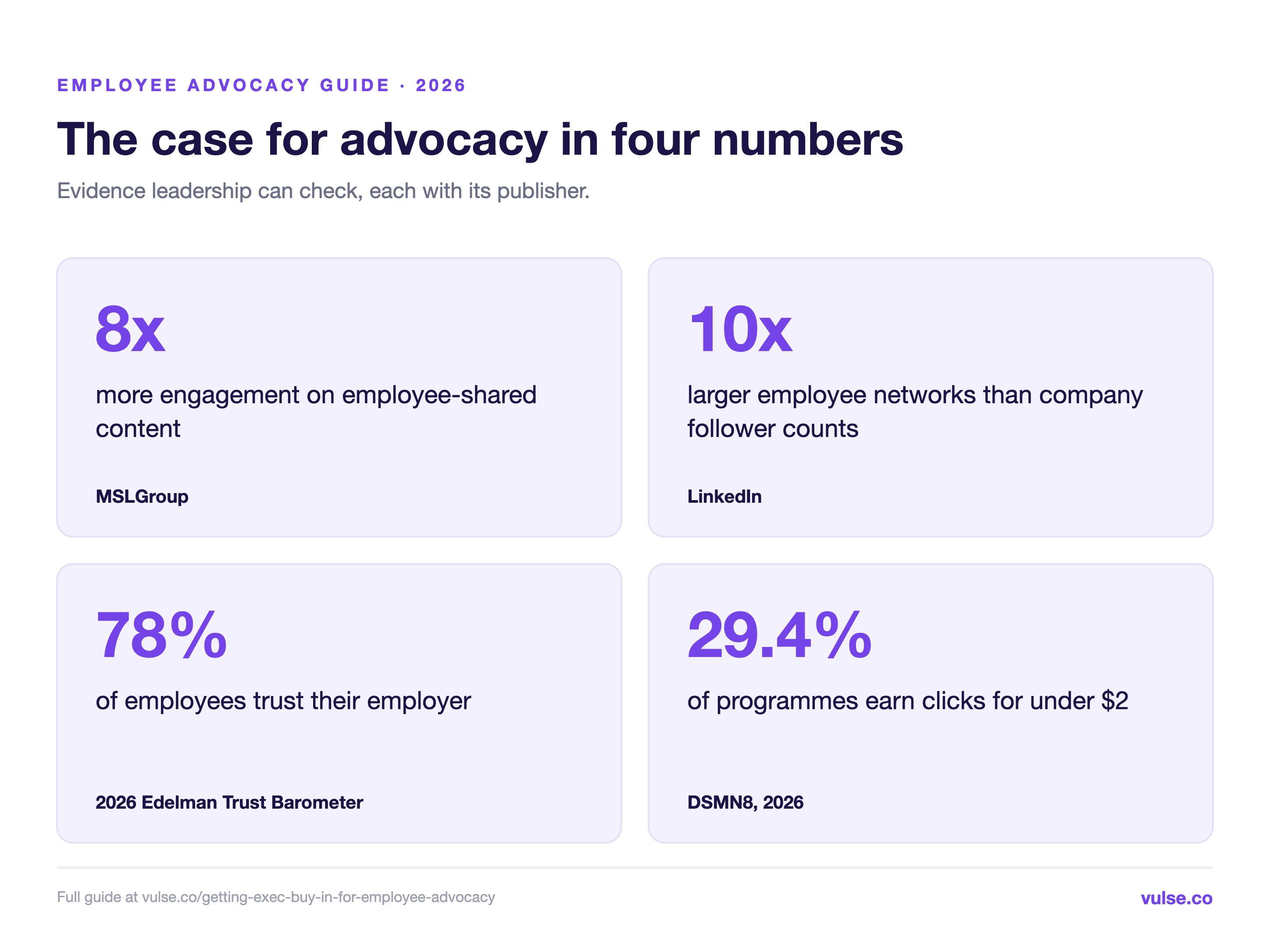
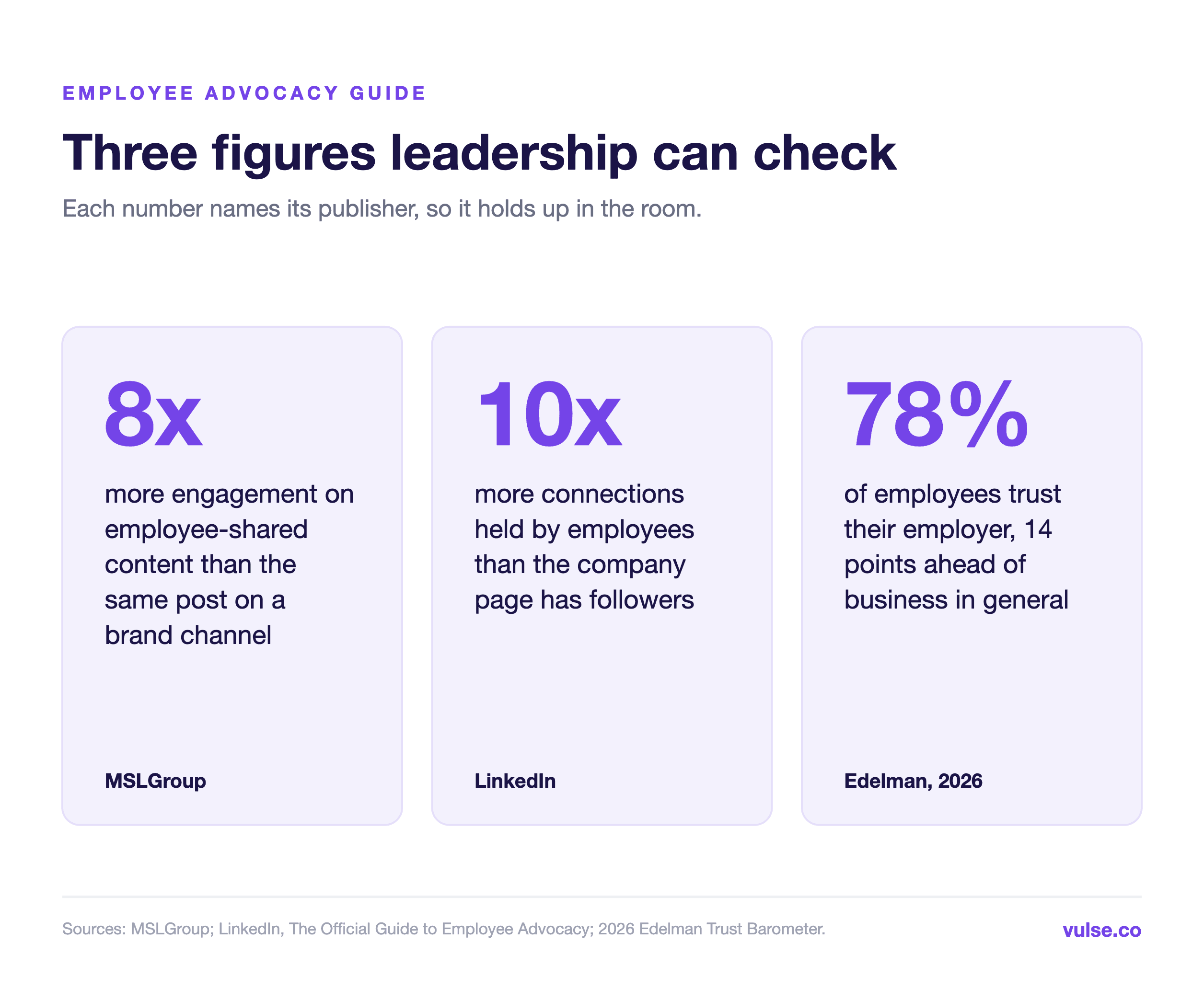
Executives respond to evidence they can check, so open with three figures that each name their publisher. Employee-shared content earns around 8x more engagement than the same post on a brand channel (MSLGroup). Employees hold roughly 10x more connections than the company page has followers (LinkedIn). And 78% of employees trust their employer, 14 points ahead of business in general (2026 Edelman Trust Barometer). Together they answer the first question in the room: why would this reach further than the channels we already run? Keep the sources on the slide. A number with a publisher attached moves through an approval meeting far more smoothly than one without.
Answer The 'Why Now' Question
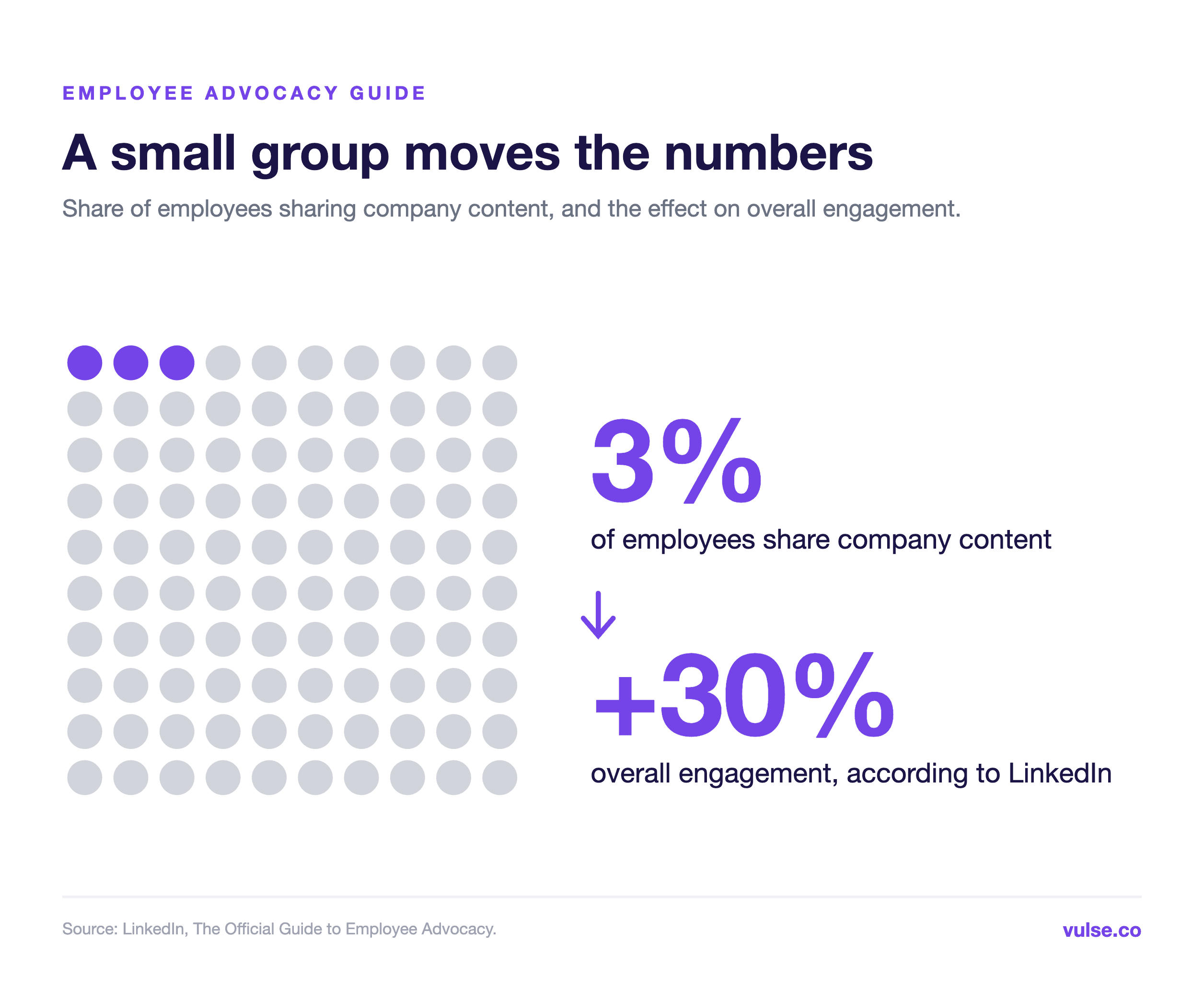
Competitors are already active on LinkedIn profiles, so an early start builds share of voice while it is still available. The entry cost is low. LinkedIn found that when just 3% of employees share company content, overall engagement climbs by about 30%, so a small first cohort moves the numbers without waiting for a company-wide rollout. Leadership involvement has also become the norm. Executives take part in 79.5% of programmes in DSMN8's 2026 benchmark, which makes a visible sponsor from your own leadership team a natural next step.
Set The Cost Beside Paid Social
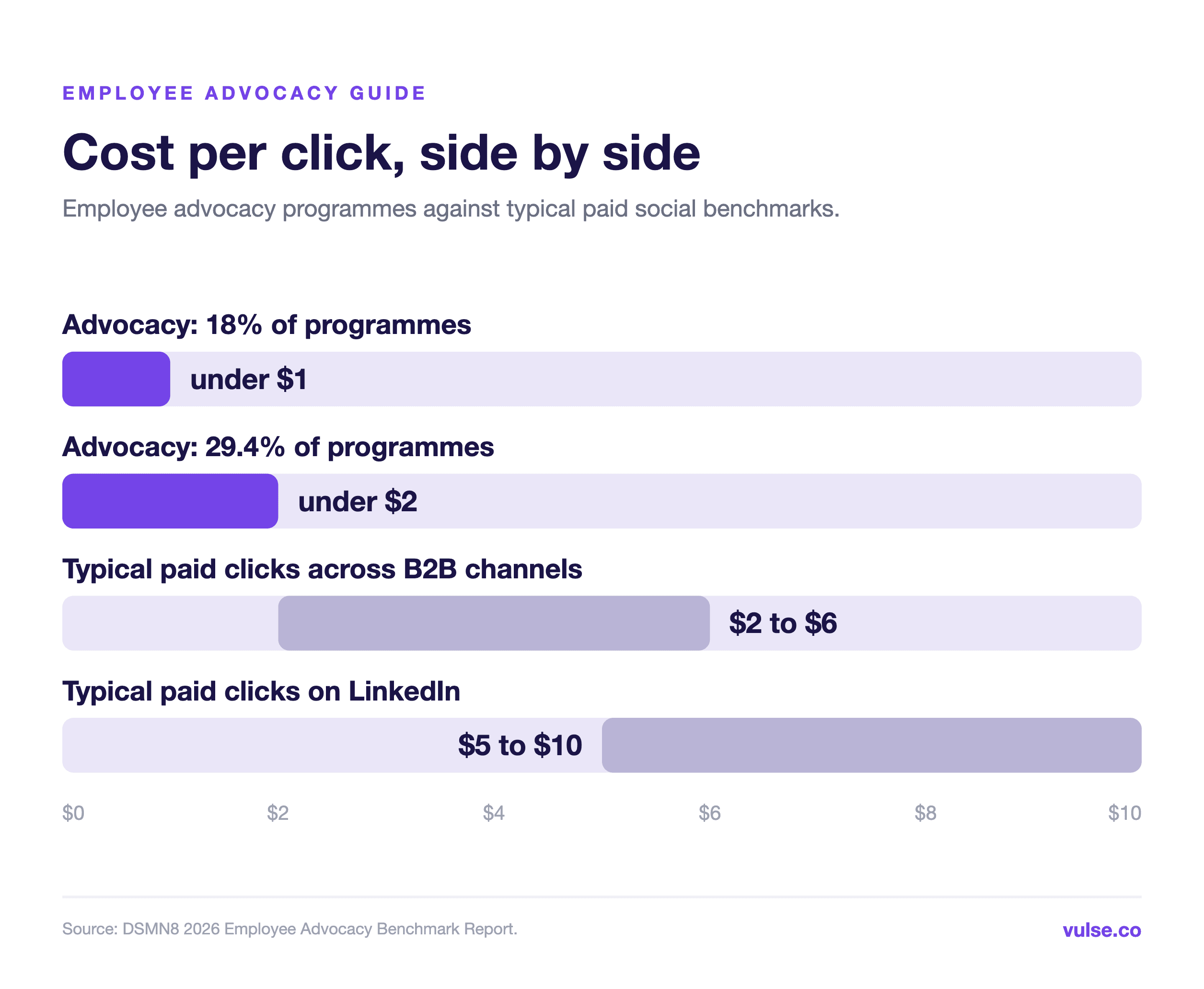
Budget holders compare every new line with the channel it sits next to, and for advocacy that channel is paid social. In DSMN8's 2026 benchmark, 18% of programmes earned clicks for under $1 and 29.4% for under $2, while typical paid clicks run $5 to $10 on LinkedIn and $2 to $6 across B2B channels. Put your programme cost and your current cost per click on the same page and let the comparison make the case. Earned media value or cost per click is the yardstick 67% of programme teams already use, so finance will recognise the measure.
Show The Time Cost Honestly
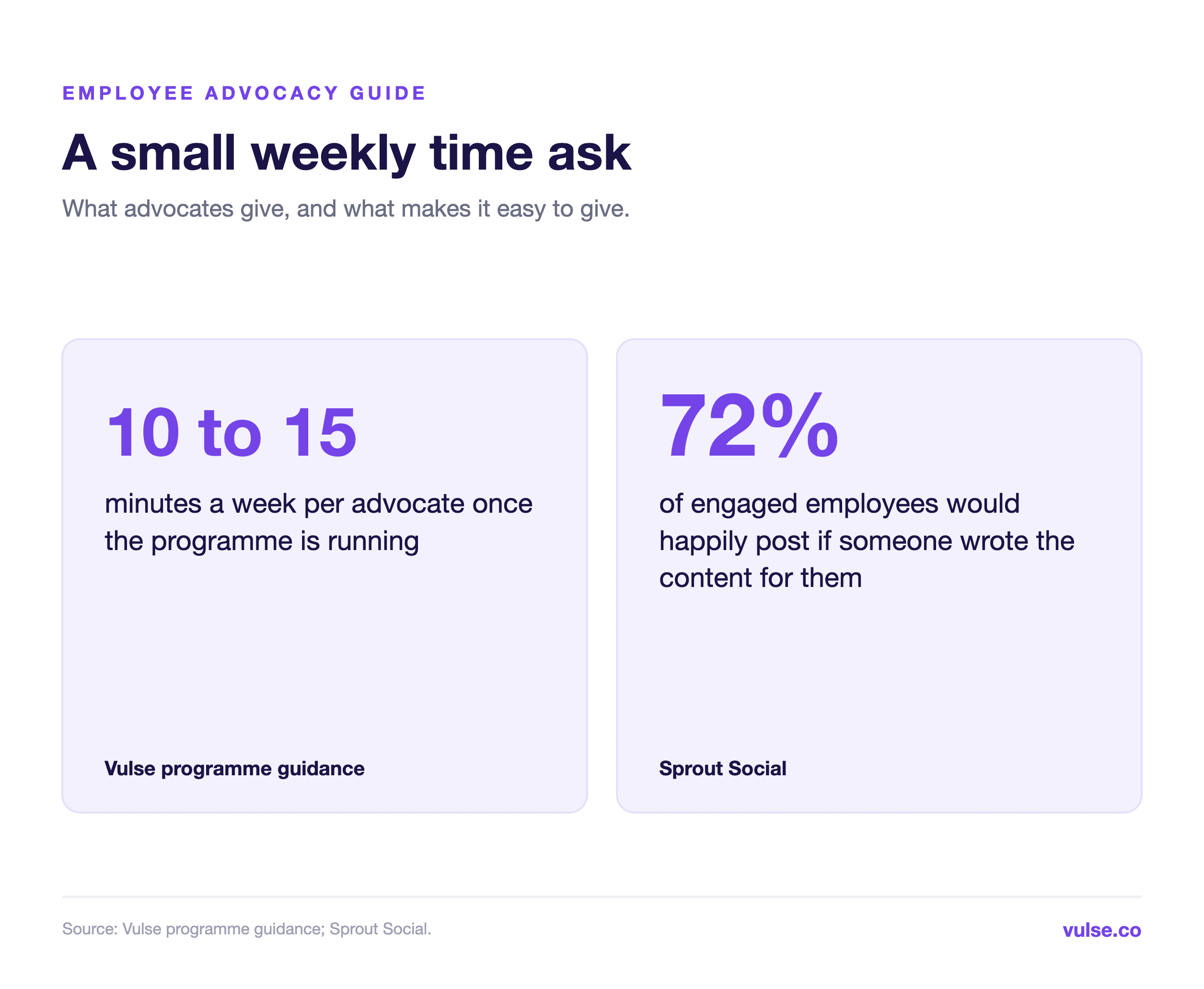
Most advocates spend ten to fifteen minutes a week once a programme is running, so put that figure in the business case. A clear time ask lets managers approve participation with confidence and lets advocates plan it into their week. Draft support keeps the figure that low. When each advocate opens the week with ideas waiting and a draft in their own voice, the time goes on reviewing and posting instead of facing a blank box. Sprout Social found that 72% of engaged employees would happily post about their company if someone wrote the content for them.
Bring Compliance In Early
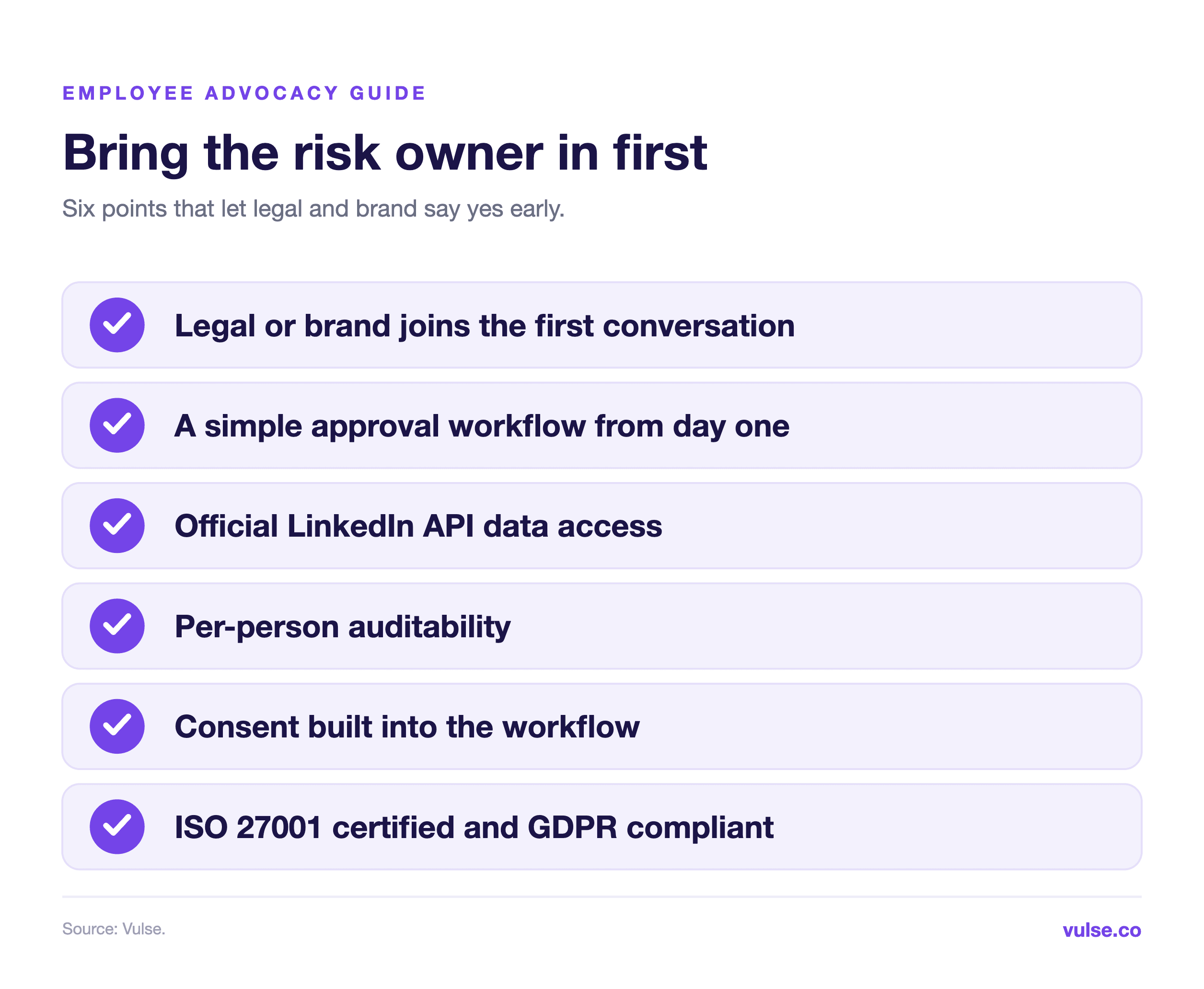
Involve your legal or brand team in the first conversation, and bring a simple approval workflow with you from day one. Executives approve faster when the risk owner has already said yes. Show the infrastructure alongside the process: official LinkedIn API access, per-person auditability and consent built into the workflow. Vulse is ISO 27001 certified and GDPR compliant, which is why teams in financial services and other regulated sectors run their programmes on it. Our Brand Safety and Compliance guide covers the full checklist.
Bring A One-Page Summary
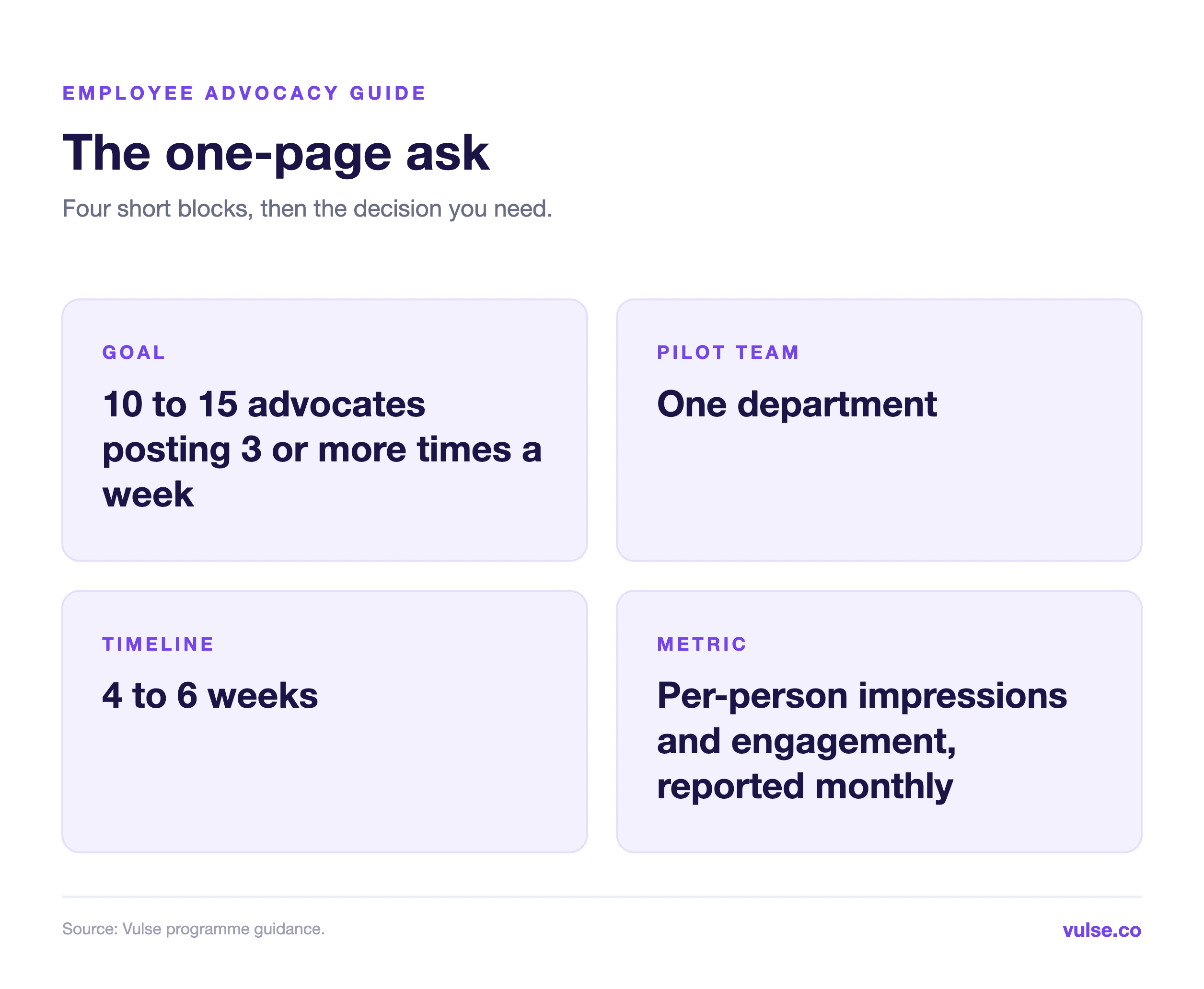
Executives respond well to a single page: the goal, the pilot team, the timeline and the metric you will report back. Keep it to four short blocks, one sentence each. A workable shape looks like this. The goal is a cohort of ten to fifteen advocates posting three or more times a week, the cadence where impressions compound in Vulse's analysis of 700 million LinkedIn impressions. The pilot team is one department. The timeline is four to six weeks. The metric is per-person impressions and engagement, reported monthly. Close with the decision you need: a yes to the pilot.

Lead With Existing Reach
Show leadership the audience size your team already commands on LinkedIn before asking for budget or headcount.

Frame It As Earned Media
Position advocacy as a channel that multiplies your paid and organic spend together.

Pilot With One Team First
A four to six week pilot with a single department gives you real numbers to bring back to the room.

Tie It To Pipeline
Track how many opportunities trace back to a shared post, and lead with that number.

Vulse is a great tool. It has already made a difference to us and the fact that the tool is still evolving and the team is so receptive to feedback means I am just stoked to see where this takes us.
Elliot Gaspar, Founding Director, Standard Ledger
Executive buy-in for employee advocacy: frequently asked questions
Lead with sourced evidence, propose a small pilot and put the ask on one page. Cite figures leadership can check, such as employee-shared content earning around 8x more engagement than the same post on a brand channel (MSLGroup), then offer a four to six week pilot with one team and commit to reporting per-person impressions and engagement.
Four tend to land well: around 8x more engagement on employee-shared content (MSLGroup), employee networks roughly 10x larger than company follower counts (LinkedIn), 78% of employees trusting their employer (2026 Edelman Trust Barometer) and clicks under $2 for 29.4% of programmes against typical paid LinkedIn clicks of $5 to $10 (DSMN8, 2026).
Four to six weeks with a single department gives you real numbers to bring back to the room. Recruit ten to fifteen willing advocates, ask for three or more posts a week and review impressions and engagement per person at the end.
Most advocates spend ten to fifteen minutes a week once a programme is running. Ideas waiting at the start of the week and a draft in the advocate's own voice keep the time focused on reviewing and posting.
Compare cost per click with paid social, track how many opportunities trace back to a shared post and report per-person reach monthly. In DSMN8's 2026 benchmark, 18% of programmes earned clicks under $1 and 29.4% under $2, against typical paid LinkedIn clicks of $5 to $10.
A senior sponsor who is ready to post personally. Executives are involved in 79.5% of programmes (DSMN8, 2026), and Tribal Impact's research across 860 B2B companies found that VP and Director activity leads employee activity by one to two months.