LinkedIn's Comment Ranking Update: Relevance Now Beats Being First
- LinkedIn Strategy
Published 18 August 2026•Updated 11 September 2026•By Rob Illidge
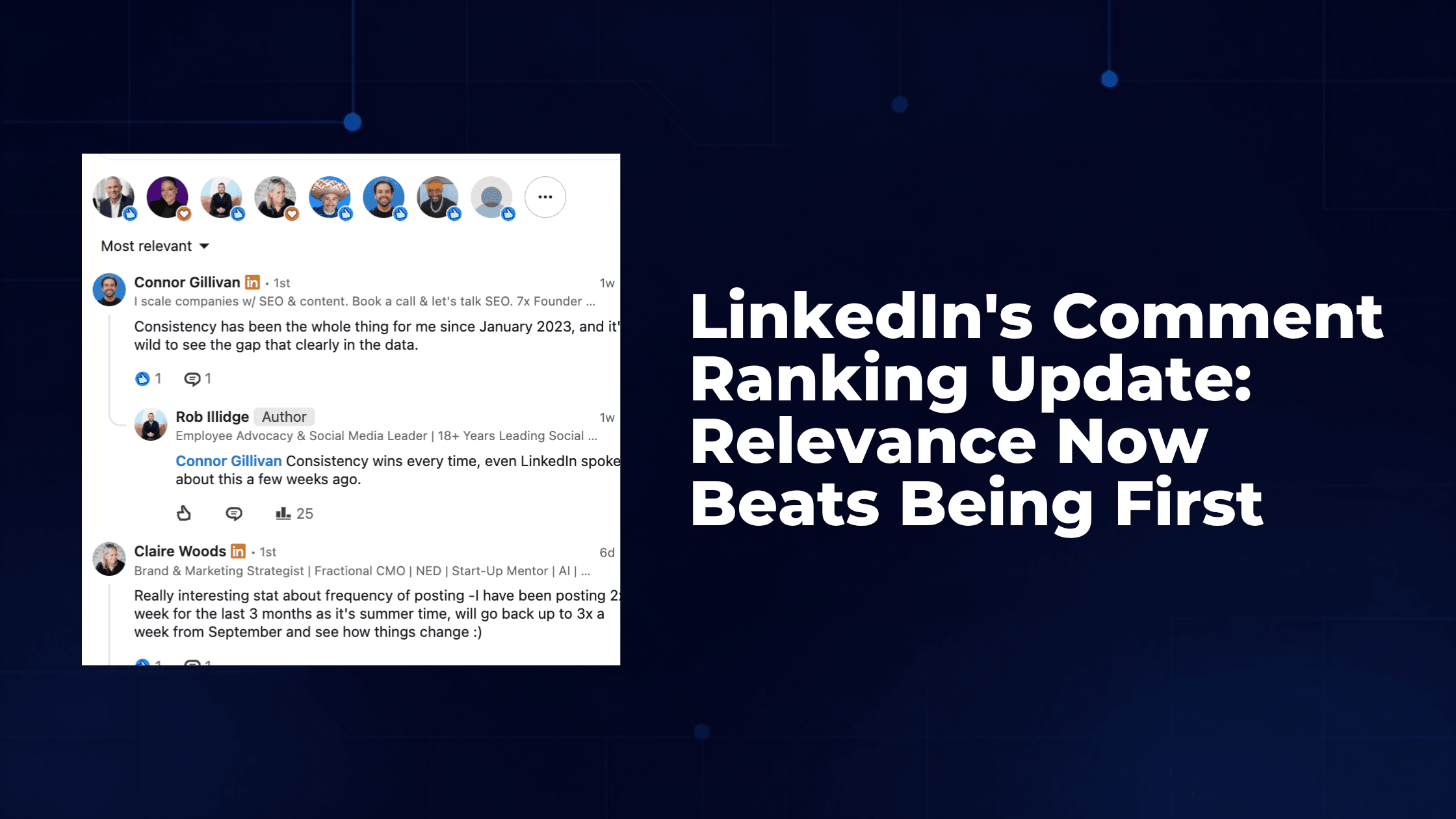
On August 9, 2026, LinkedIn changed how comments appear under a post. Instead of showing them in the order they were written, the feed now ranks comments by how relevant each one is to the person reading it. It sounds like a small tweak, but for anyone who has built a habit of commenting fast to grab the top slot, the ground just shifted. Being first no longer wins. Being relevant does.
What LinkedIn Changed
The update, confirmed by LinkedIn and reported by Social Media Today, covers two connected moves. First, comment ranking is now personalized: the comments you see near the top of a post are the ones the system predicts you will find most useful, not simply the earliest or the ones with the most likes. Second, LinkedIn is surfacing more timely and relevant discussions across the feed to pull people into conversations they actually care about.
To decide what is relevant, LinkedIn leans on signals it already knows about each member, including professional interests, the connections you share with the commenter, and your past engagement activity. In practice, two people looking at the same post can now see a different comment order, each tuned to what is likely to resonate with them.
The motivation is straightforward. LinkedIn reported an 18 percent year-over-year jump in time spent inside post comments during the second quarter of 2026, alongside a 10 percent annual rise in overall content consumption. Comments have become one of the most active surfaces on the platform, and LinkedIn wants to make that space feel worth participating in rather than a wall of noise.
Why This Matters
For years, a common LinkedIn tactic was speed. Turn on notifications for a big account, fire off an early comment, and ride the visibility of the top position. Engagement pods formalized the same logic by coordinating quick reactions and replies to game reach. This update quietly dismantles that playbook. If your comment is generic or unrelated to the reader's interests, it can now sink no matter how early you posted it.
There is a second force pushing in the same direction. Analysis cited around the change suggested that roughly 30 percent of comments posted between April and June 2026 were AI-generated. LinkedIn has been visibly working to protect authenticity, including a new option to privately report posts and comments that look like AI slop. Relevance-based ranking is the other half of that effort. When the system rewards comments that genuinely fit the reader, low-effort and automated replies lose their easy path to visibility.
This connects to a broader pattern in how the LinkedIn algorithm now works. The platform has steadily moved away from raw engagement volume and toward relevance and meaningful interaction. The comment update is the same philosophy applied to a surface where a lot of professional conversation actually happens.
What It Means for Marketers, Founders, and Creators
If you build authority on LinkedIn, this is mostly good news, provided you were already trying to add value rather than just rack up activity. Thoughtful comments that speak directly to a post's topic and audience now have a better chance of being seen by the exact people you want to reach. A sharp, specific reply on a well-targeted post can put you in front of a decision maker far more efficiently than another cold connection request.
The flip side is that shortcuts get punished. Broad, copy-paste comments like "Great post" or "So true, thanks for sharing" were always weak, and now they are close to invisible. Volume-based commenting strategies and pods will deliver less because the ranking no longer rewards the behaviors they depend on.
For brands and personal-brand builders, the practical shift is from quantity to fit. It becomes more important than ever to understand which conversations your audience actually cares about, and to show up in those with something substantive to say. Knowing which of your posts and comments drive real profile visits and follows, rather than vanity reactions, is where paying attention to your LinkedIn analytics and engagement data starts to pay off.
How to Adapt Your Approach
You do not need a new strategy so much as a sharper version of a good one. A few adjustments line up cleanly with how relevance ranking behaves:
- Comment where you have real expertise. Relevance signals reward alignment between your professional interests and the post's topic, so choose conversations you can genuinely add to.
- Make each comment a mini-contribution. Add a specific example, a counterpoint, a number, or a lesson learned. Comments that stand on their own tend to earn replies, which deepens the thread.
- Prioritize posts from your target network. Because shared connections and interests feed the ranking, engaging within your actual professional community carries more weight than commenting on random viral posts.
- Drop the pods and the templates. Coordinated and canned engagement is exactly what this update is designed to discount, and it now risks looking like the AI slop members can report.
- Design your own posts to invite replies. Ask a question, take a clear position, or leave a deliberate gap for others to fill. More on-topic replies means a richer comment section that the algorithm is now built to surface.
- Stay consistent. Relevance is learned over time, so a steady rhythm of posting and commenting on your core themes teaches the system what you are about. Reliable content planning and scheduling makes that cadence far easier to hold.
Summary
LinkedIn's comment ranking update is a small mechanical change with a clear strategic message. The platform is doubling down on relevance and authentic contribution, and it is stripping value out of speed, volume, and automation. For anyone building a genuine reputation on LinkedIn, that is a welcome direction. The winning move is no longer to comment first, but to comment in a way that is unmistakably worth reading. For more breakdowns of how these shifts affect your reach, the Vulse blog keeps track of what is changing and how to respond.
Frequently Asked Questions
What changed with LinkedIn comment ranking in August 2026?
LinkedIn now displays comments under a post based on how relevant each one is to the individual viewer, rather than showing them in chronological order. Two people can see a different comment order on the same post, each personalized to their interests and network.
Does commenting first on LinkedIn still help visibility?
Not the way it used to. Because comments are now ranked by relevance rather than timing, being early no longer guarantees a top spot. A later comment that is more relevant to the reader can now outrank an early, generic one.
What signals does LinkedIn use to rank comments?
LinkedIn uses signals it already tracks, including your professional interests, your shared connections with the commenter, and your past engagement activity, to predict which comments you are most likely to find useful.
Do engagement pods still work on LinkedIn?
They work far less well. Relevance-based ranking discounts coordinated, low-context engagement, and LinkedIn is separately cracking down on inauthentic and AI-generated comments, so pod-driven activity is losing its ability to boost visibility.
How should marketers respond to the comment ranking update?
Focus on relevance over volume. Comment where you have real expertise, add specific and substantive value, engage within your target professional community, and design your own posts to invite genuine replies rather than relying on templates or pods.