LinkedIn's New Network Tab: Why Your Connections Just Became Your Most Valuable Audience
- LinkedIn Strategy
Published 22 September 2026•By Rob Illidge
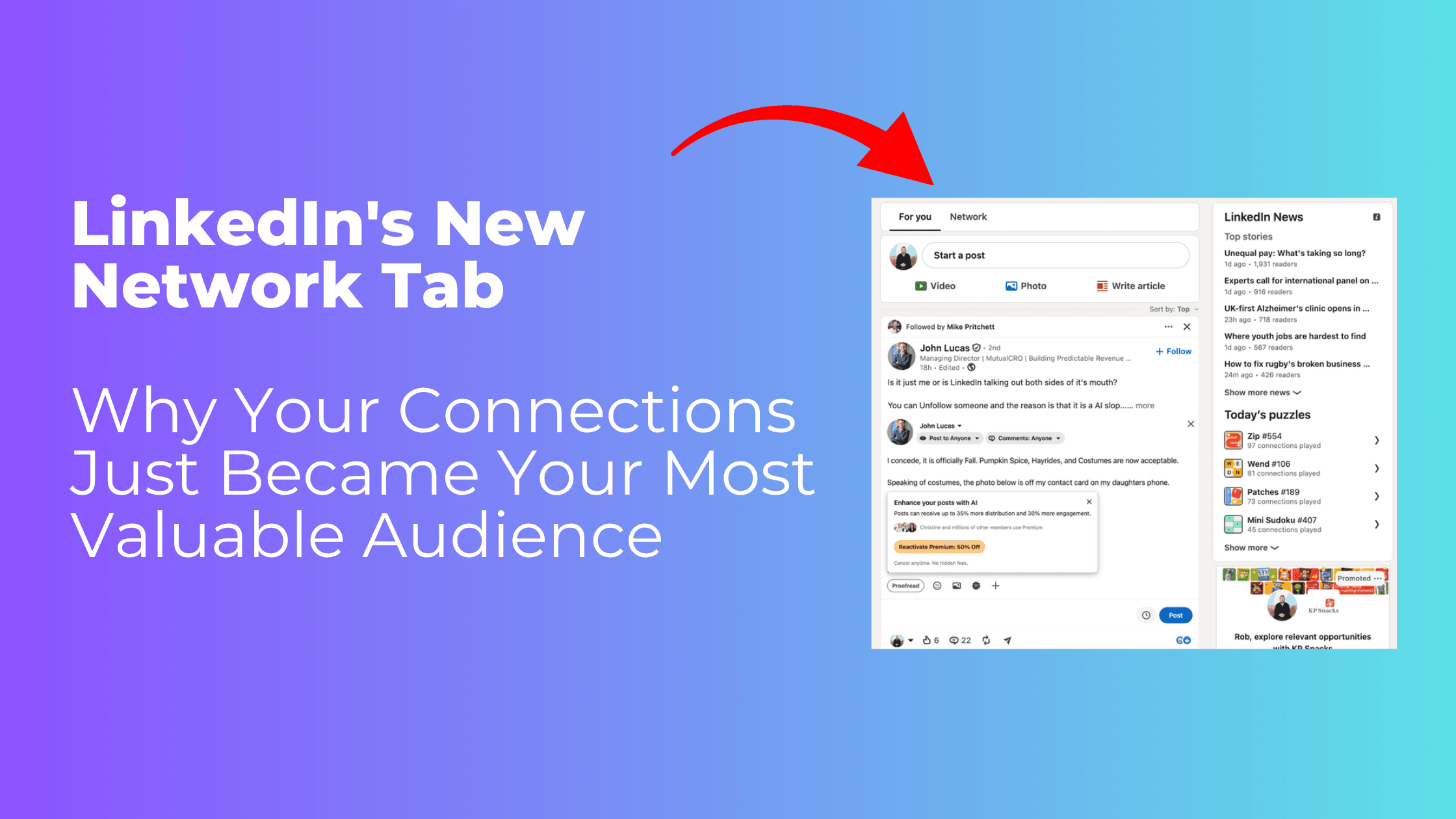
LinkedIn is testing a second feed. Instead of the algorithm deciding what you see, a new Network tab shows you posts only from the people you have deliberately connected with or followed.
LinkedIn's Chief Product Officer, Hari Srinivasan, announced the trial in a post on 18 September 2026, describing it as a way to "stay connected to your network, ie the people you have explicitly connected or followed." He said: "We all want more real connection with real people, and we hope this plays a small part in rebuilding that world."
For anyone responsible for a company's LinkedIn presence, this should change how you think about content. Here's why, and what to do about it.
What LinkedIn is actually testing
The Network tab sits at the top of the feed as a design change to the share box area. Tap it and the recommendation engine steps aside. You see updates from your first-degree connections and the people and pages you follow, in a feed built on relationships rather than predicted interest.
Social Media Today reported the test on 20 September, noting it follows a run of alternative feed experiments: multiple suggested feeds in 2025 and topic-based feeds in June 2026. Neither of those rolled out widely.
So there is a fair chance this one stays a test too. But the direction of travel matters more than any single feature. LinkedIn has spent the past year tightening up on engagement pods, adding reporting tools for low-effort generated content, and now building a feed that rewards genuine relationships. Every one of those moves points the same way.
The shift: from reach to relationships
For years, LinkedIn content strategy has been an exercise in feeding the algorithm. Hook in the first line, dwell time, comment velocity, post at 8am on a Tuesday. All of it designed to get a post in front of strangers.
A Network feed flips the question. If a growing share of your audience chooses to view only the people they know, then the number of relevant connections your content can travel through becomes the ceiling, and the quality of those relationships becomes the multiplier.
Three things follow from that.
1. Personal profiles beat company pages by an even wider margin
Company pages already lag behind individual profiles on organic reach. In a connections-first feed, the gap widens. People connect with people. A company page can only be followed, and follows are passive. A connection is a two-way decision that carries a relationship with it.
The employees of your business collectively have connections your page will never reach. A 50-person team with an average of 800 connections each covers 40,000 first-degree relationships. Your company page might have 3,000 followers. In a Network feed, the team wins by an order of magnitude.
2. Who you are connected to matters more than how many
A network built on random connection requests is worth less in this model. If your sales team is connected to 2,000 people, but only 200 of them are buyers, a Network feed surfaces content to all 2,000 with equal weight.
The practical implication is that connection strategy becomes a content strategy question. Who are your employees connected to? Do those connections match your ideal customer profile? This is worth auditing before you invest in more posting.
3. Recognisable voices get read
In an algorithmic feed, a well-written post from a stranger can perform brilliantly. In a Network feed, the reader already knows the author. That changes what earns attention. Familiarity, consistency and a clear point of view do more work than a clever hook.
It also raises the bar on authenticity. A feed of people you actually know makes templated, ghostwritten or interchangeable posts more obvious. If ten colleagues share the same copy on the same morning, a Network feed shows that plainly to anyone connected to several of them.
How to adjust your LinkedIn content approach now
You do not need to wait for the test to conclude. The behaviours a Network feed rewards are the same behaviours that already work, just with the incentives sharpened.
Move the weight of your output from the page to the people. Treat the company page as a source library and the employees as the distribution layer. If most of your publishing effort currently goes into the page, reverse it.
Give employees a starting point, not a script. Shared themes, data points and stories work. Identical copy does not. Each person should sound like themselves. A well-run employee advocacy programme provides the raw material and lets the individual shape it.
Audit connection quality across the team. Pull a sample of your advocates' networks and check them against your buyer profile. Where there are gaps, make connecting with the right people a deliberate part of the programme.
Post with a rhythm people can recognise. Consistency is what turns a connection into someone who expects to hear from you. Two or three posts a week from each advocate, on a recognisable set of topics, builds that expectation.
Comment as much as you post. In a relationship-led feed, showing up in the comments of a connection's post keeps you visible to them and their network. It also builds the two-way relationships that a Network feed is designed to surface.
Measure reach by relationships, not vanity. Impressions from strangers matter less. Track engagement from people who match your buyer profile, profile views from target accounts, and the conversations that start in the DMs afterwards. Our guide to measuring employee advocacy ROI covers the framework.
What this means for employee advocacy
Employee advocacy has always rested on one idea: people trust people they know more than they trust brands. The Edelman Trust Barometer has shown this consistently for years.
A Network tab turns that idea into product design. If LinkedIn builds a feed that shows only the people you have chosen to connect with, then the only route into that feed is through someone the reader already knows. For most B2B companies, that someone is an employee.
Whether or not this particular test ships, LinkedIn has now said out loud what it wants: real connection with real people. Building your content approach around that is the safe bet either way.
Frequently asked questions
What is the LinkedIn Network tab?
The Network tab is a feed LinkedIn is testing that shows posts only from your first-degree connections and the people or pages you follow. It sits alongside the main algorithmic feed as an alternative view.
Is the Network tab available to everyone?
Not yet. LinkedIn announced it as a test on 18 September 2026. Previous alternative feed tests were scaled back, so there is no confirmed rollout date.
How does the Network tab affect company page reach?
Company pages are followed rather than connected to, so they compete with every other follow in the feed. Personal profiles, which carry two-way connections, are better placed to appear in a Network feed.
Should we change our LinkedIn strategy because of a test?
The behaviours a Network feed rewards, such as authentic personal posting, consistent presence and quality connections, already outperform on LinkedIn today. Adjusting now carries little risk and positions you well if the feature rolls out.
How does employee advocacy help with a connections-first feed?
Employees hold the first-degree connections a company page cannot. An advocacy programme gives them content to share in their own voice, which is the only reliable way into a feed built on personal relationships.