EMPLOYEE ADVOCACY PROGRAM
How to Run an Employee Advocacy Program That Survives Month Three
Most employee advocacy programs fade around month three. Here is what the data says about building one that compounds: who to recruit, what cadence to hold, how to keep ideas arriving, and what to measure. Built on 700 million LinkedIn impressions.
What An Employee Advocacy Program Actually Is
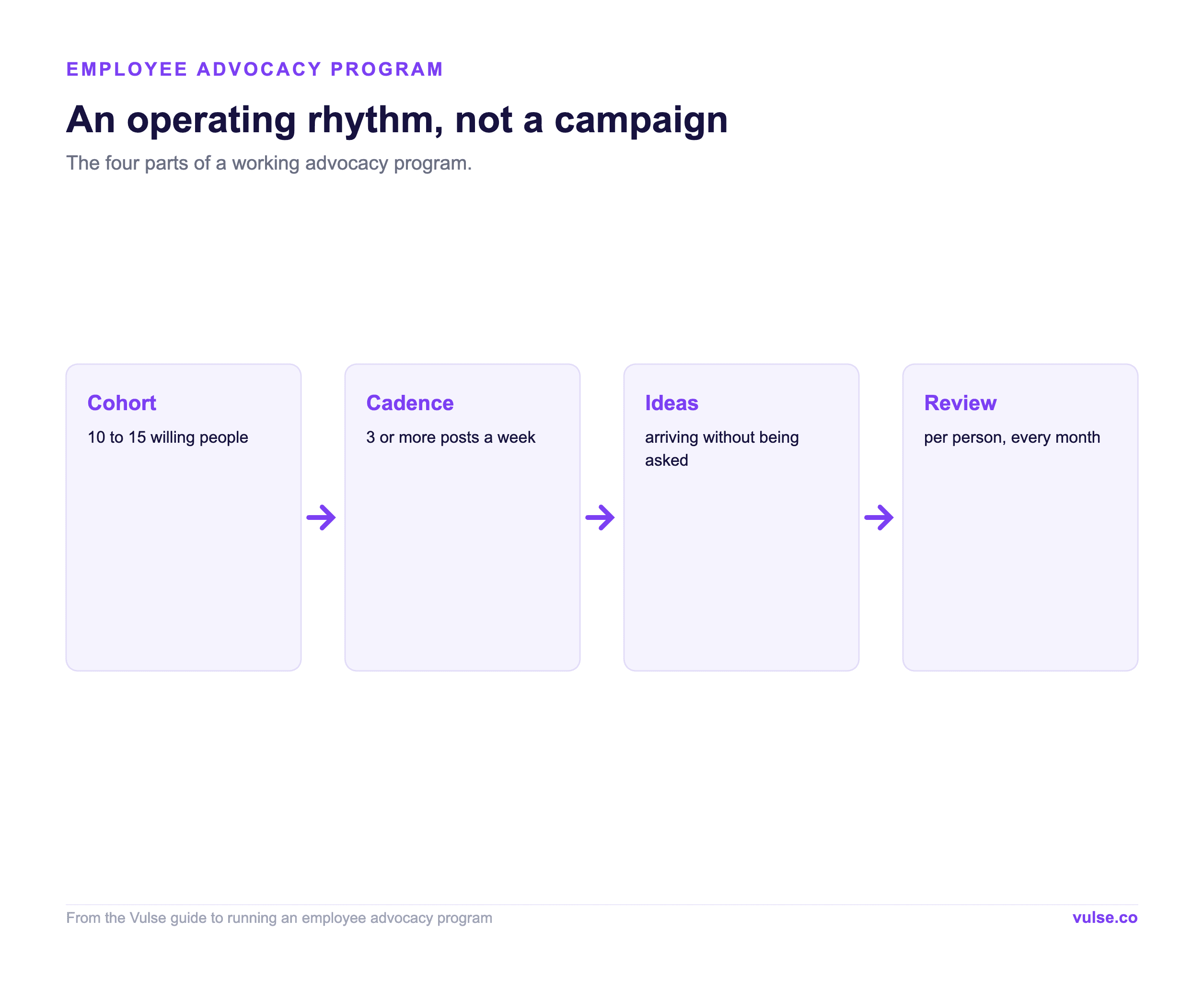
A structured way of helping your people share content about their work on their own LinkedIn profiles, with the company providing ideas, drafting support and measurement. Done well it looks less like a campaign and more like an operating rhythm: a defined cohort, a cadence, a supply of ideas, and a monthly review of who is growing.
Why Programs Fade At Month Three
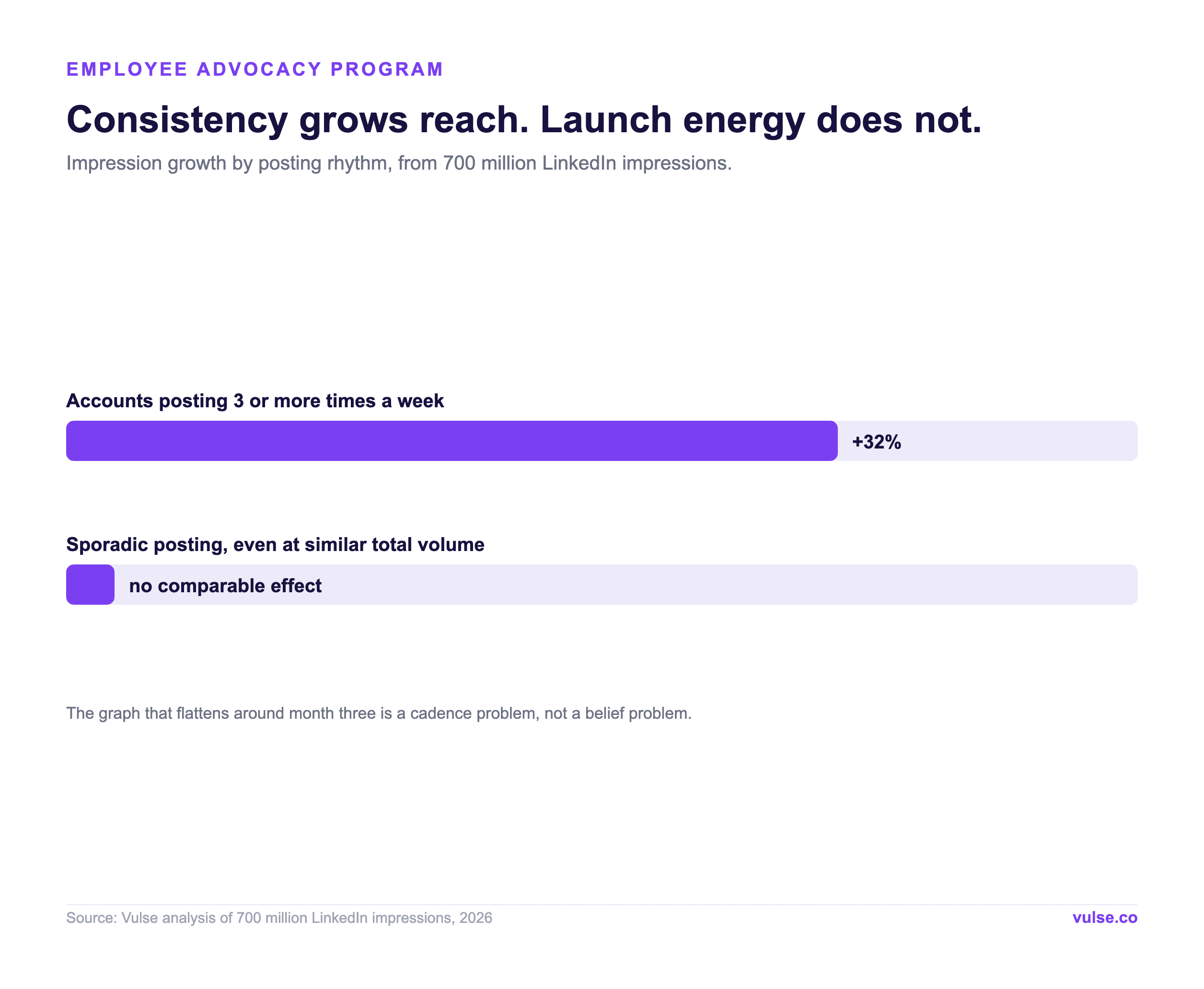
The most common design mistake is launching like a campaign. A burst of training and a content calendar produce a strong first month, then posting reverts to a daily decision each employee makes alone, and the graph flattens. The mechanism that grows reach is consistency: in our analysis of 700 million LinkedIn impressions, accounts posting three or more times a week grew impressions by 32%, while sporadic posting at similar total volume stayed well short of that lift. Build the program around protecting that rhythm instead of around launch energy.
Recruit The Willing, Not The Many
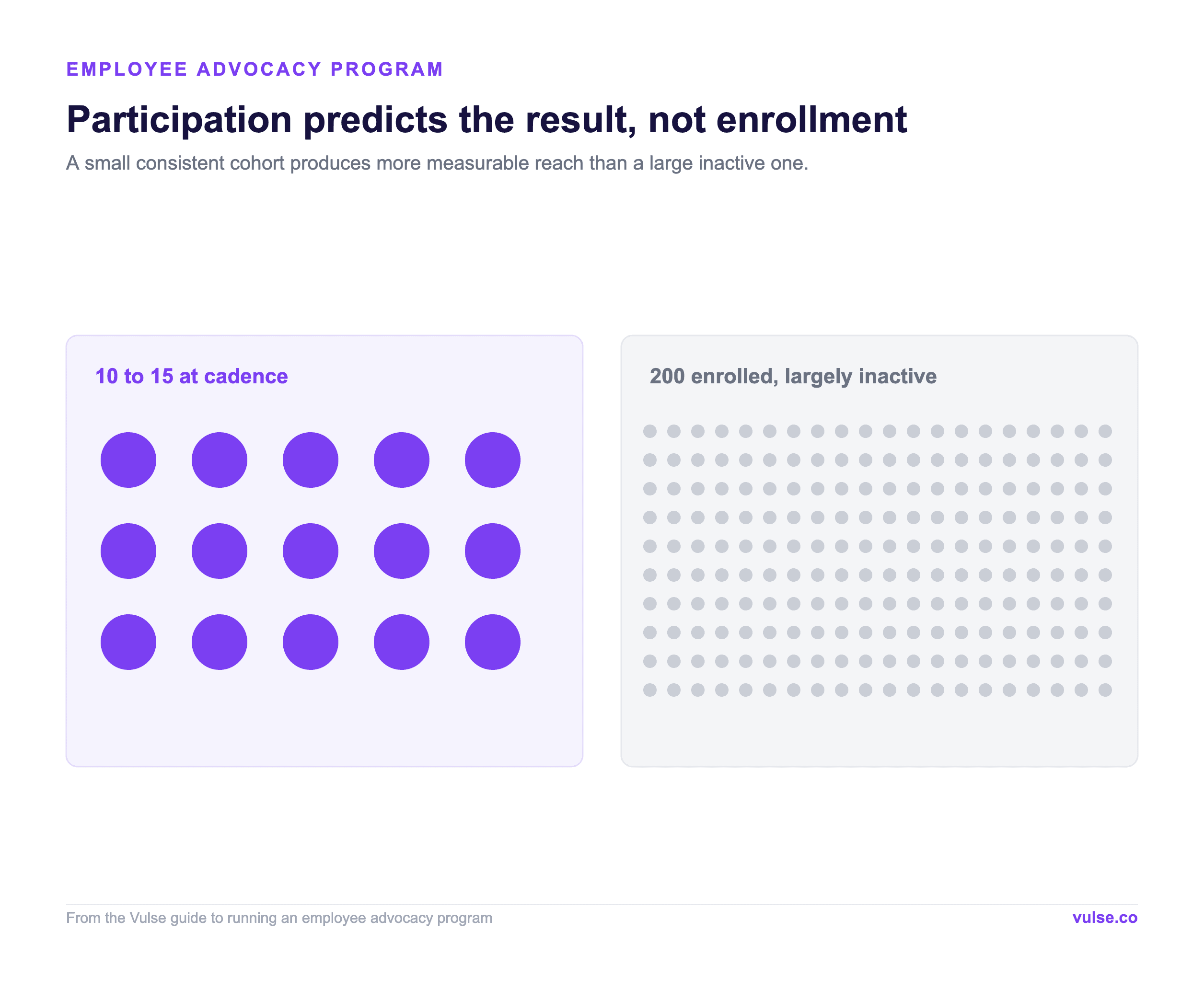
Start with ten to fifteen people who already want to be visible: your natural posters, your subject experts, the salespeople who see the point. Enrollment is the number that goes in the launch announcement. Participation is the number that predicts the result, and a small consistent cohort produces more measurable reach than two hundred people signed up and largely inactive. Concentrate support on them, build internal proof, and let the program earn its way outward.
Set Themes And A Cadence, Per Person
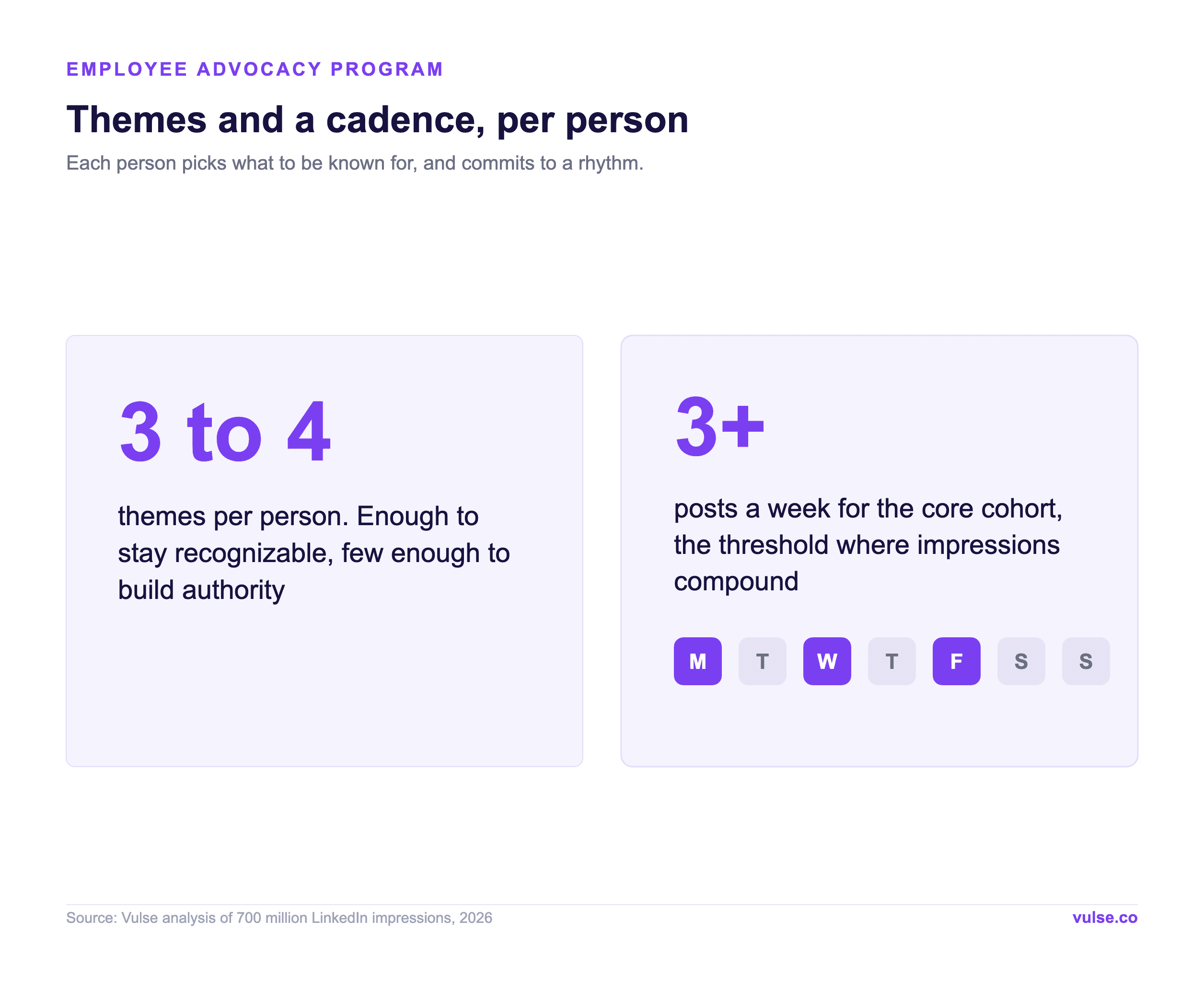
Each person picks three or four themes they want to be known for, and commits to a rhythm. Three or more posts a week is where the data shows impressions compounding, and it is also how LinkedIn's feed builds an individual's credibility on a topic. Leadership can hold a lighter signaling rhythm, because their activity exists to keep the layers below moving. Your core cohort belongs at the threshold.
The Leadership Layer Moves First
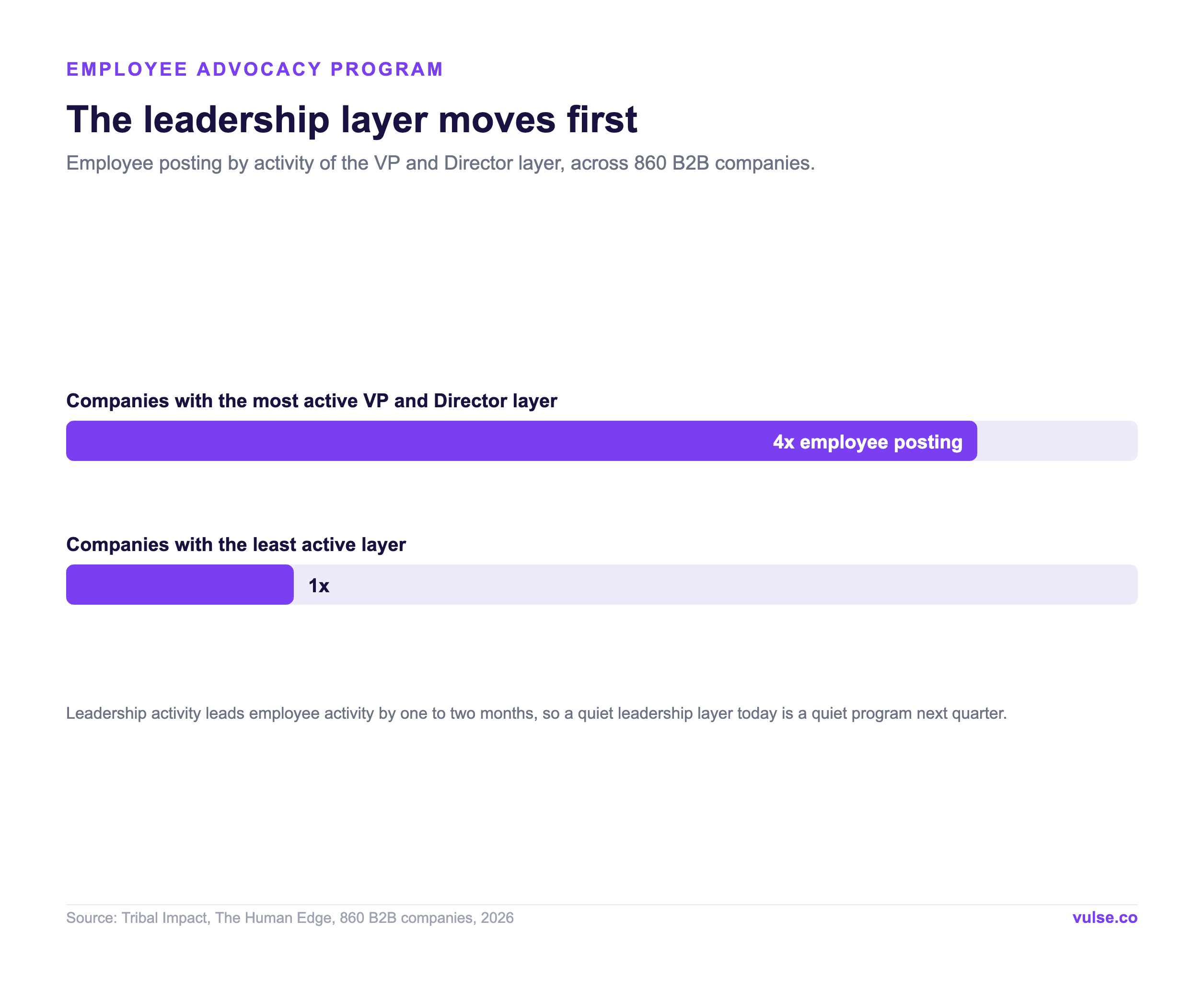
Research from Tribal Impact across 860 B2B companies found that VP and Director activity leads employee activity by one to two months, and that companies with the most active middle layer see four times the employee posting of those with the least. A quiet leadership layer today is a quiet program next quarter, so track leadership cadence as its own line, and treat a dip there as your earliest warning.
Make Ideas Arrive Without Being Asked
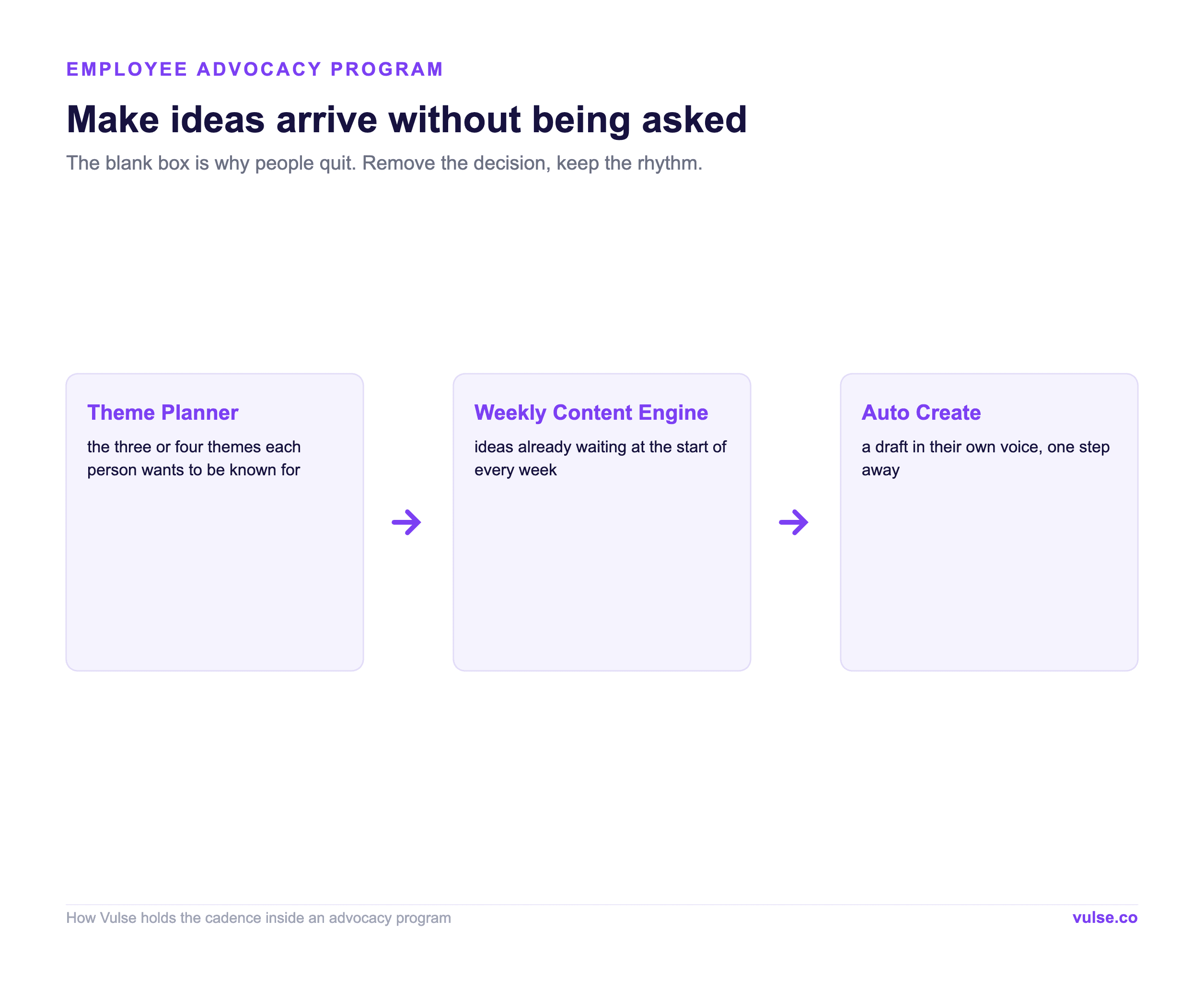
People step back from advocacy for a practical reason: deciding what to say comes round three times a week, forever, and the blank box wins on a busy Tuesday. The operational job of a program is removing that decision: every person opens their week with ideas already waiting, drawn from their own themes, with a draft in their own voice one step away. This is what Theme Planner, the Weekly Content Engine and Auto Create do inside Vulse.
Measure People, Not Totals
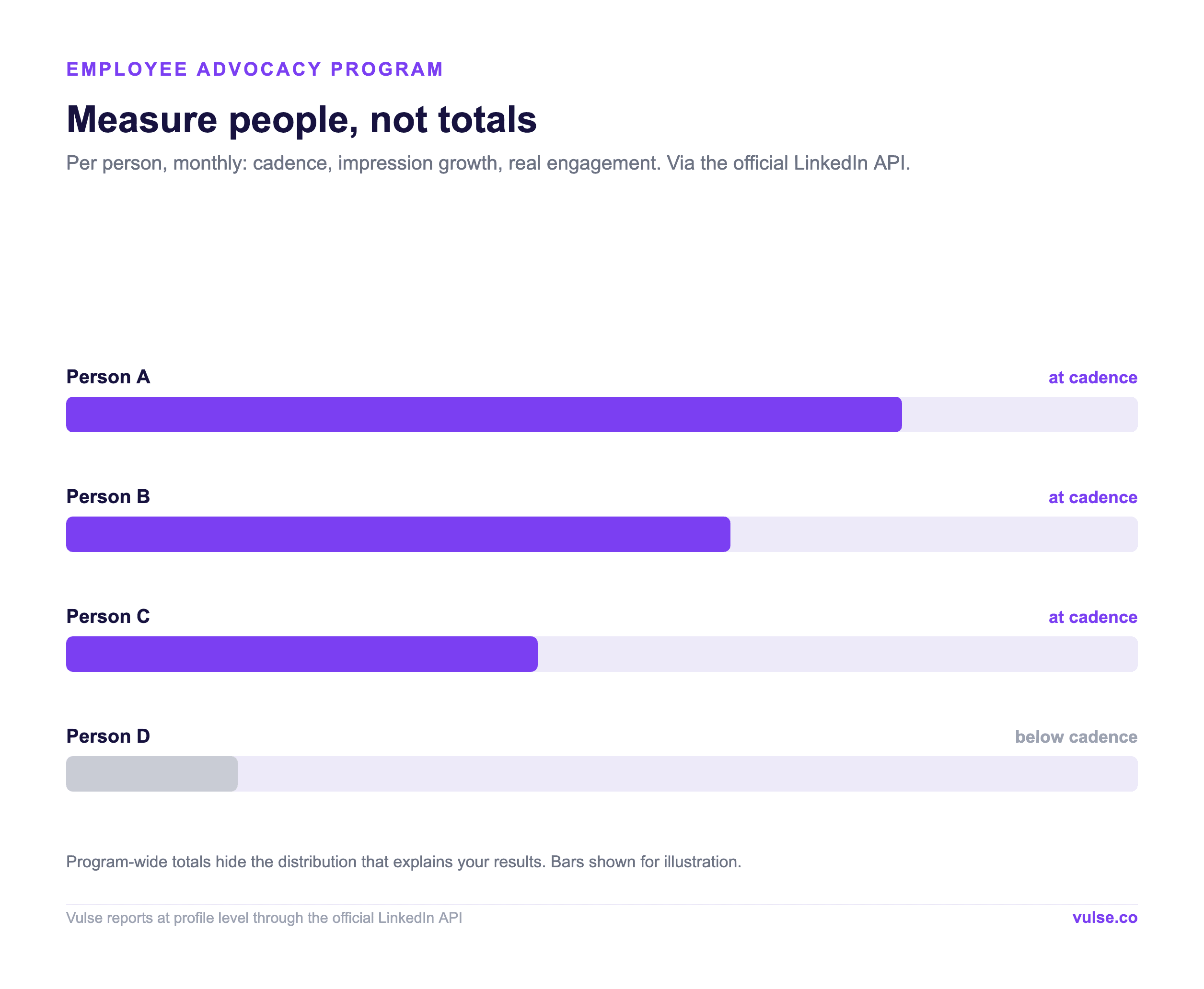
Program-wide totals hide the distribution that explains your results. The numbers that matter are per person, monthly: who is at cadence, whose impressions are growing, whose engagement is real. Vulse reports at profile level through LinkedIn's official API, the measurement LinkedIn itself retired from company pages in November 2024. For turning the numbers into a business case, see our framework on how to measure employee advocacy ROI.
Running Advocacy In Regulated Industries
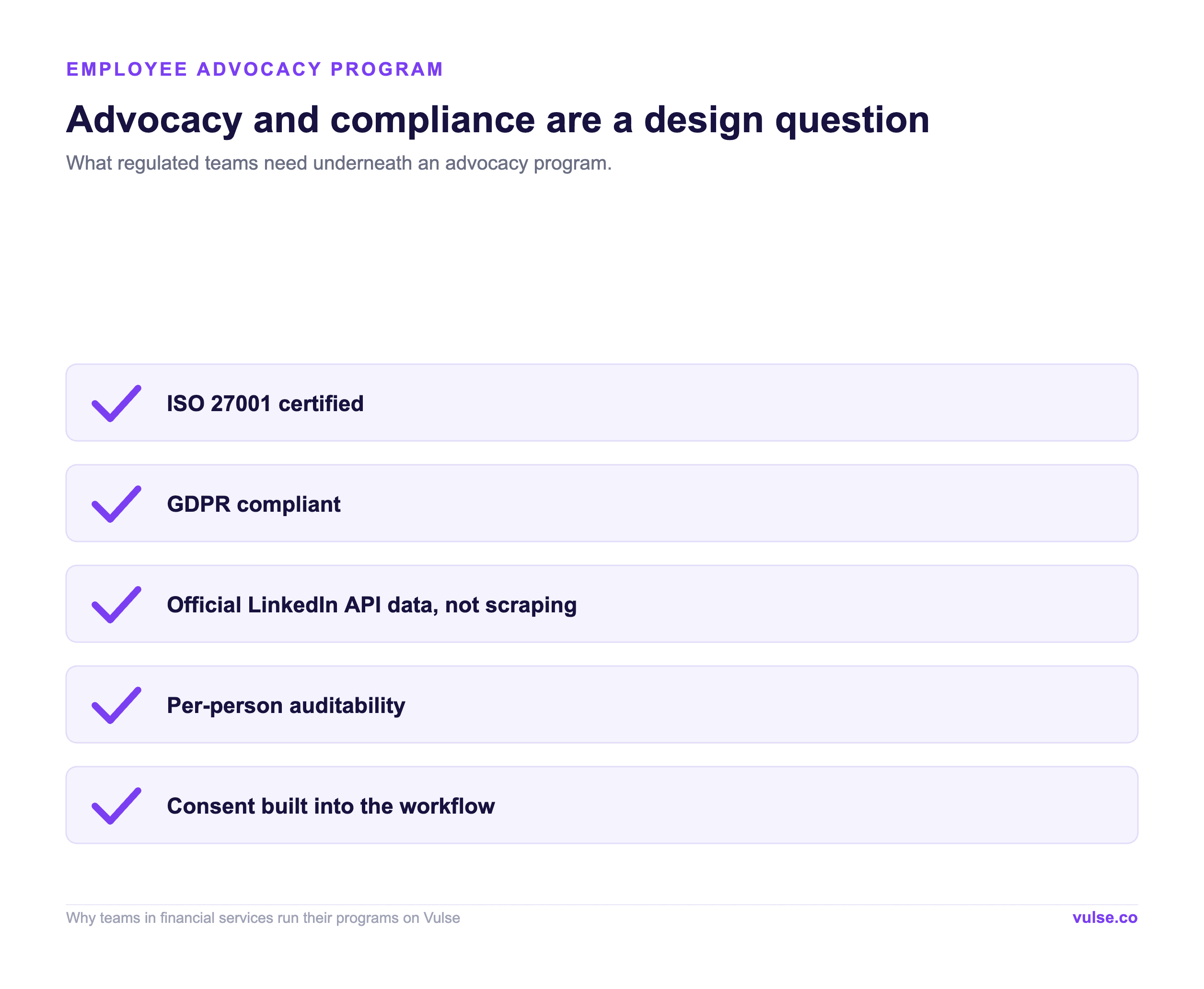
Advocacy and compliance work well together once you treat them as a design question. Most advocacy content, hiring, culture, industry education and thought leadership, sits outside promotional territory when the line is drawn properly once. What regulated teams need underneath it is infrastructure: official data access, per-person auditability, and consent built into the workflow. Vulse is ISO 27001 certified and GDPR compliant, which is why teams in financial services and other regulated sectors run their programs on it.
Choosing Software For The Program
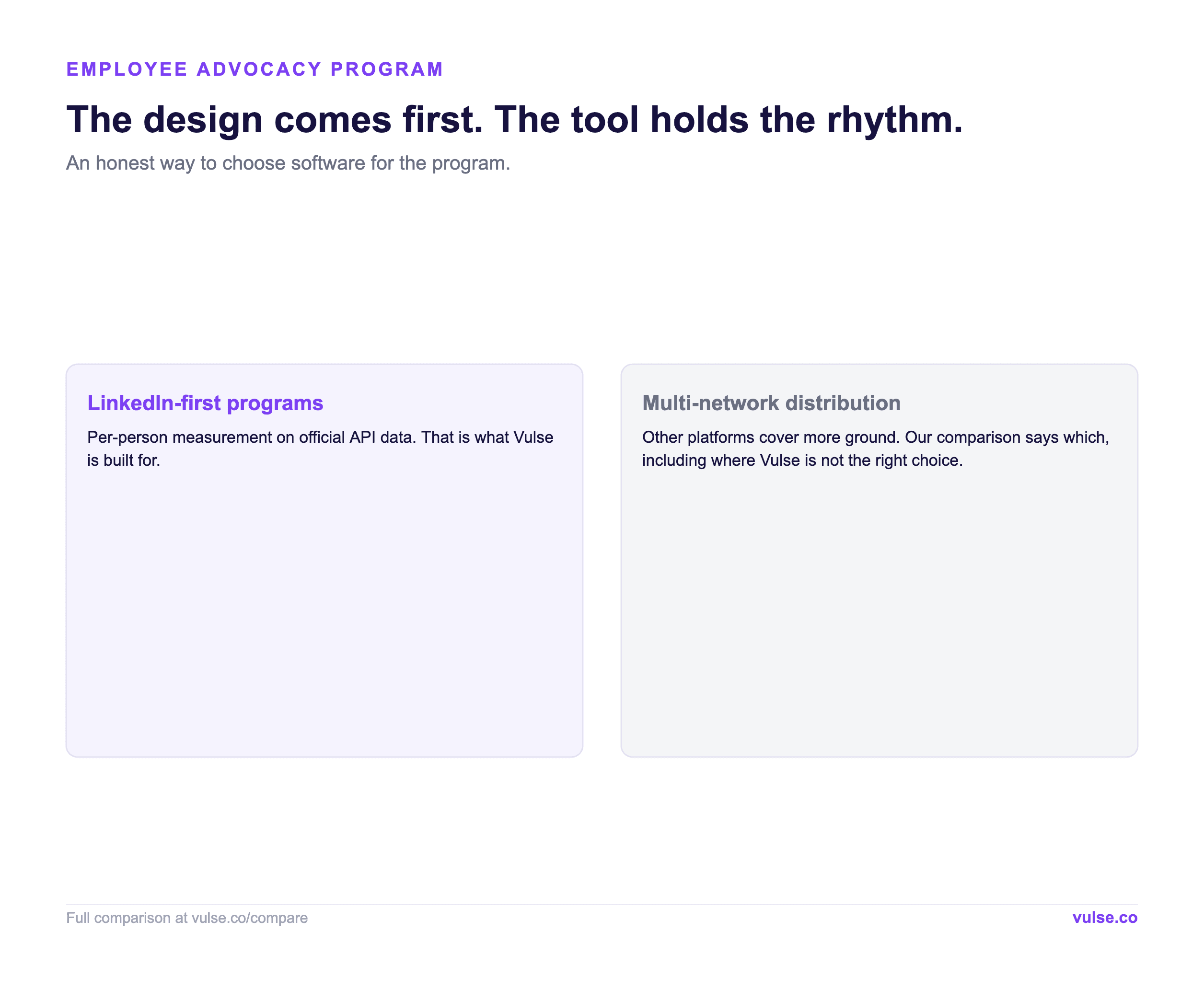
The program design comes first; the tool exists to hold the rhythm. If LinkedIn is where your audience is and you want per-person measurement on official data, that is what Vulse is built for. If you need multi-network distribution, other platforms cover more ground, and our side-by-side comparison of the main options shows which fits where, including the situations where another platform suits better.
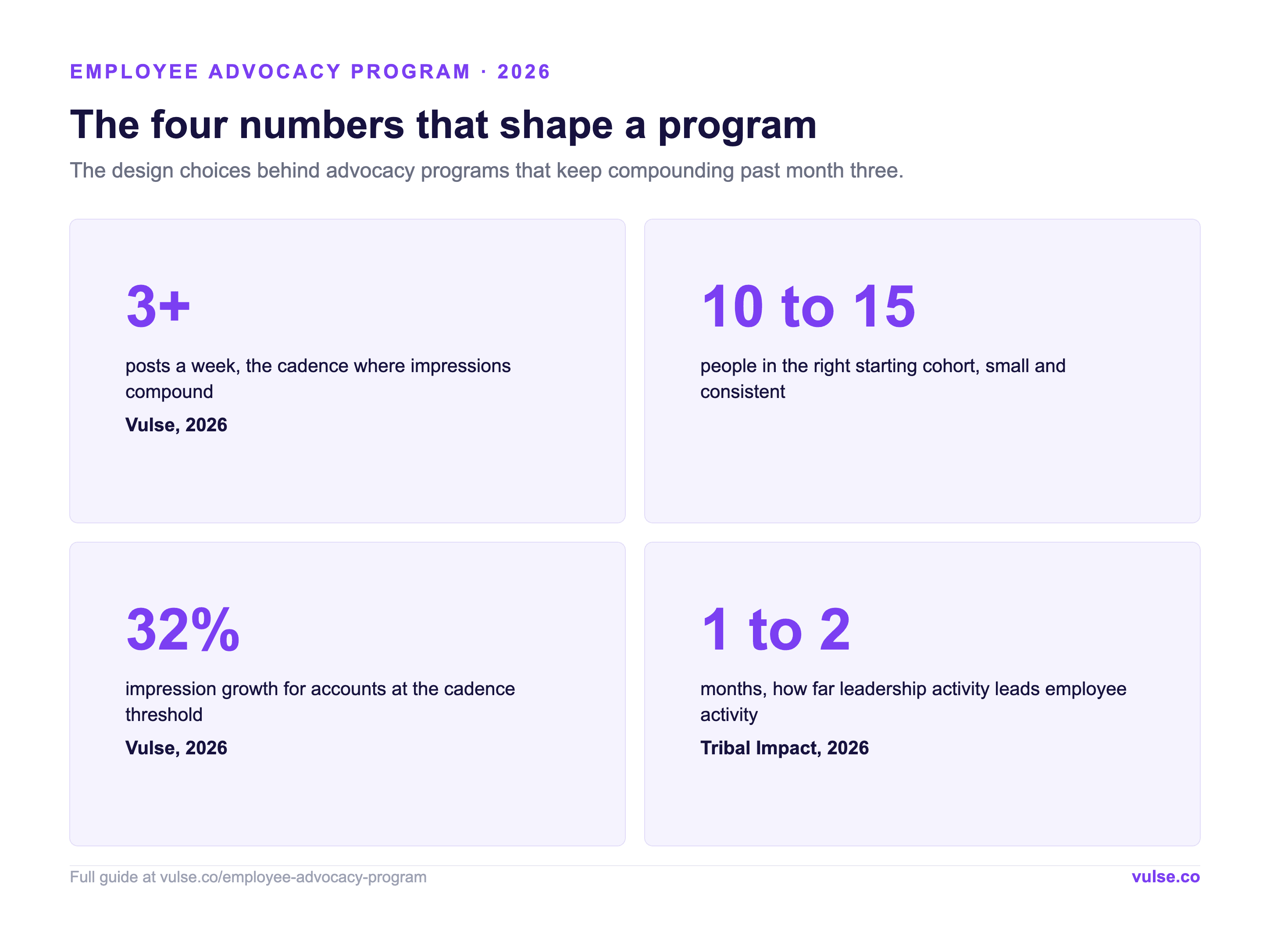
3+ Per Week
The posting cadence where impressions compound (Vulse, 2026)
10 To 15
The right starting cohort. Small and consistent beats large and enrolled

3 To 4 Themes
Topics per person. Enough to stay recognizable, few enough to build authority
1 To 2 Months
How far leadership activity leads employee activity (Tribal Impact, 2026)
32%
Impression growth for accounts at the cadence threshold (Vulse, 2026)

14x
More engagement on employee posts than company pages (Vulse, 2026)

700 Million
LinkedIn impressions behind the benchmark, via official API
Same-Day Setup
Most teams are posting within the first week

Vulse has allowed me to analyze post performance. My impressions and engagement have increased.
Marcell Edwards, Global Talent Acquisition, Adidas
Employee advocacy program: frequently asked questions
A structured way of helping employees share content about their work on their own LinkedIn profiles, with the company providing ideas, drafting support and measurement. The goal is consistent, credible individual voices rather than rebroadcast brand content.
Ten to fifteen willing people is the right starting cohort. A small consistent group produces more measurable reach than a large enrolled one, and their results become the internal proof that recruits everyone else.
Three or more times a week for your core cohort. Our analysis of 700 million LinkedIn impressions found accounts at that cadence grew impressions by 32%. Leadership can hold a lighter rhythm, since their activity exists to signal that the behavior matters.
Invitations work better than quotas. Mandated activity produces compliance posting that audiences and LinkedIn's feed both discount. Hold the cadence with a willing cohort, make ideas effortless to act on, and let internal proof do the recruiting.
Per person, monthly: the share of the cohort at three or more posts a week, individual impression and engagement growth, and leadership cadence as its own line. Program-wide totals hide the distribution that explains results.
Engagement typically lifts within the first month. Compounding reach takes a quarter of steady posting, which is why programs should be reviewed on cadence monthly rather than judged on reach quarterly.
Their own profiles. That is the point: employee posts earned up to 14 times more engagement than equivalent company page content in our data, because audiences trust people over logos.
Yes, Vulse includes a review step: drafts route to a manager or admin before they publish, on top of the pre-approved themes and one-page policy most programmes start with. It's built on the same official, profile-level LinkedIn data as the rest of the platform, so governance and measurement run on one connected system.